SOUTHBURY – A decision on whether to fund proposed Flock license plate reader cameras within the town has been put on pause following Monday’s Board of Finance meeting.
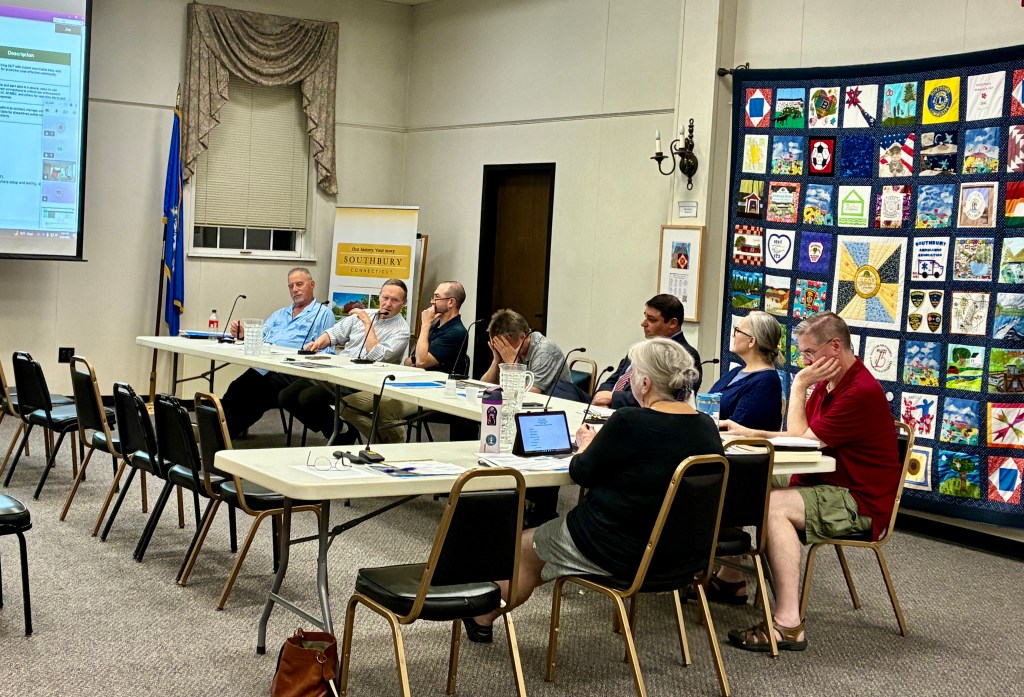
The Board of Finance met for nearly three hours, ultimately deciding to postpone consideration of the two-year contract until it receives additional information from the Board of Selectmen; the matter is expected to return no later than the board’s September meeting.
Finance Director Dan Colton also outlined the approval process should the proposal move forward, stating that if the Board of Finance and the Board of Selectmen vote in favor of advancing the proposal, the final decision would ultimately be made at a Town Meeting where residents would vote on appropriating the funds.
The meeting also revealed a discrepancy in the plan’s cost that had been presented to town officials.
While the proposal had originally and repeatedly been described as a $42,500 two-year contract, Board of Finance Chairman John Michaels noted that the actual cost totaled $39,250. The discrepancy stemmed from a $3,250 one-time installation fee that had already been included in the first year’s cost. The pricing discrepancy had not been identified during earlier Board of Selectmen discussions or in a June 24 memo from the First Selectman.
Four members of the public spoke during the public comment period, all expressing their concerns about the proposed plan to install five license plate reading cameras around town.
First Selectman Tim O’Neil, Police Chief Christopher Grillo, and Flock account executive Joe DiStefano attended the meeting virtually.
A Pause for More Answers
In the decision to postpone the consideration of the funding request, the Board of Finance is seeking more answers to additional questions developed during Monday’s meeting.
Some of those questions have to do with the technology and the handling of data itself, along with a broader question of whether the Board of Finance should weigh in on policy implications or just stick to evaluating the fiscal impact of the proposal.
Michaels, the long-time chair of the Board of Finance, noted that it has been a tradition to give “great deference” to the Board of Selectmen on policy decisions, with intervention coming only in rare circumstances.
He pointed to last year’s debate over the defunding of the full-time Economic Development Director position as an example of one of the few times the finance board has done so.
“We do that extremely rarely,” Michaels said. “The Board of Selectmen believes that, for public safety, and in the Chief’s testimony in making our officers more efficient and effective … that’s why I think we should do this.”
Not everyone agreed.
Vivian Templeton questioned whether the proposed camera locations would even accomplish the stated goal of preventing incidents similar to last year’s vandalism at the town parks.
“This is a horrible idea for so many reasons, but the main one is the mass surveillance of innocent civilians,” said Templeton. “I will not vote for this as I understand it right now, in any way, shape, or form, because I think it’s just wrong.”
She added, “Why are we here, if not as a backstop to what [The Board of Selectmen] do sometimes?”
Board member Tom Connor agreed the board should take additional time before acting, saying, “I don’t feel bad about letting this drag through time. It feels like the type of thing we want to have a broad discussion about.”
Board member Michael Carrington also spoke about the board’s role, citing some ambiguity in the town’s charter.
He asked, “Are we the Senate to the House of Representatives that the Board of Selectmen is? Or are we something completely different?”
Carrington also acknowledged that the proposal had generated a level of public interest, as well as the rare instance of public comments at Monday’s meeting.
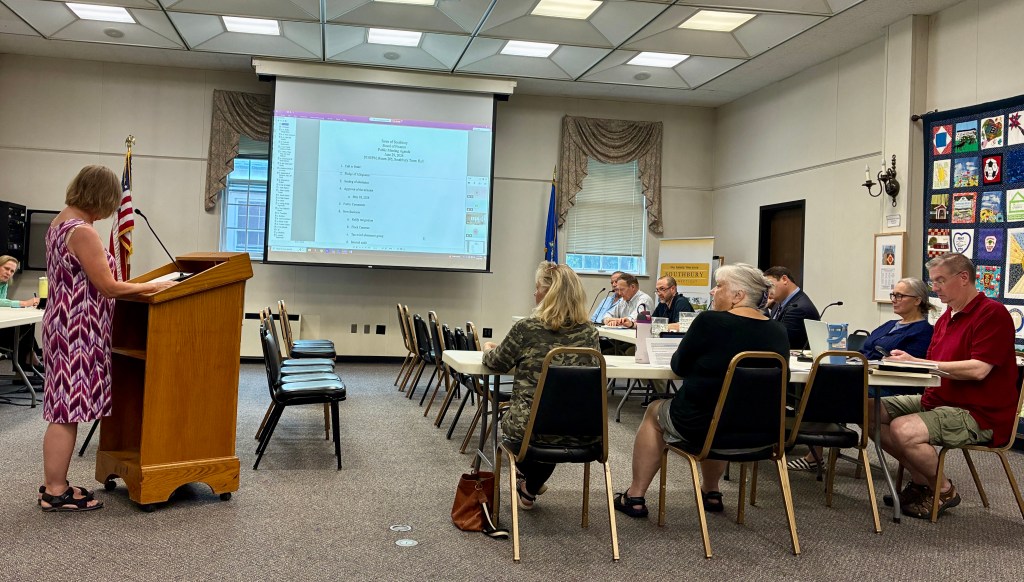
Public Comments
Ahead of the board’s discussion, four members of the public — three from Southbury and one from Oxford — urged the board to reject the proposal, saying that the cameras would collect data on every vehicle that passes them.
Jason Hoyt questioned how securely the information would be stored and whether residents would ever be aware in the case of a data leak.
“It’s us. It’s our data, and it’s our privacy,” Hoyt said.
Laura DePace said she would be one of many citizens passing the cameras multiple times every day.
“While I’m doing nothing illegal, I’m not comfortable with this level of surveillance every time I leave my house,” DePace said. “I am against the installation of these cameras on our streets.”
Oxford resident David Manning argued that the Flock camera proposal amounted to an unreasonable search of law-abiding citizens.
“The idea of installing a surveillance system that records the travel of every law-abiding citizen in order to more easily catch a few crooks is repulsive to me,” Manning said. “I don’t think it’s worth it.”
Could the Proposal Wait a Year?
Another question raised by board members, including Jack Kelly, attempted to gauge the importance and urgency of the request relative to other priorities within the Police Department’s budget.
“It wouldn’t hurt the department to wait until the next fiscal year,” Grillo responded.
Grillo later added, “Since we started looking at this project, there’s been a bunch of times where we had an investigation and I thought to myself, ‘If we only had some technology right now, that it would make this investigation easier’.”
He noted the example of an evading accident, where the department could then run a search for the vehicle that left the scene. If that type of incident were to occur today, Grillo said, officers would be sent out to look for a vehicle matching the description given.
Grillo said that being able to use technology to identify vehicles based on descriptions such as make, model, color, and possible damage, when a license plate number is not available, would “definitely be useful.”
The exchange appeared to reinforce the board’s decision to postpone action while seeking additional information.
First Selectman Tim O’Neil said he respected the board’s decision to pause the discussion and bring it back to the Board of Selectmen before further action is taken.
Speaking on the proposal in general, O’Neil said, “I think the benefits outweigh the costs.”
What’s Next
As Monday’s motion to postpone stands, the request to approve the funding for the project will now wait until responses to questions are heard from the Board of Selectmen. Included in the motion to postpone discussions is that the proposal returns before the board for funding consideration no later than its September meeting, although a special meeting could be called sooner.
Currently, the Board of Finance does not have any meetings scheduled for the months of July or August, while the next Board of Selectmen meeting is scheduled for July 16.
If the Board of Finance ultimately approves the financials behind the proposed plan, it would return to the Board of Selectmen for consideration before potentially advancing the matter to a Town Meeting, where Southbury residents would have the final vote on appropriating the funds.
Although Kelly was the lone ‘nay’ vote on the finance board to postpone the decision — saying that he would rather have a vote on it at Monday’s meeting — he acknowledged the wide interest in the topic from residents.
“The high school gym may not be large enough for that town meeting,” he said.
By Evan Triantafilidis