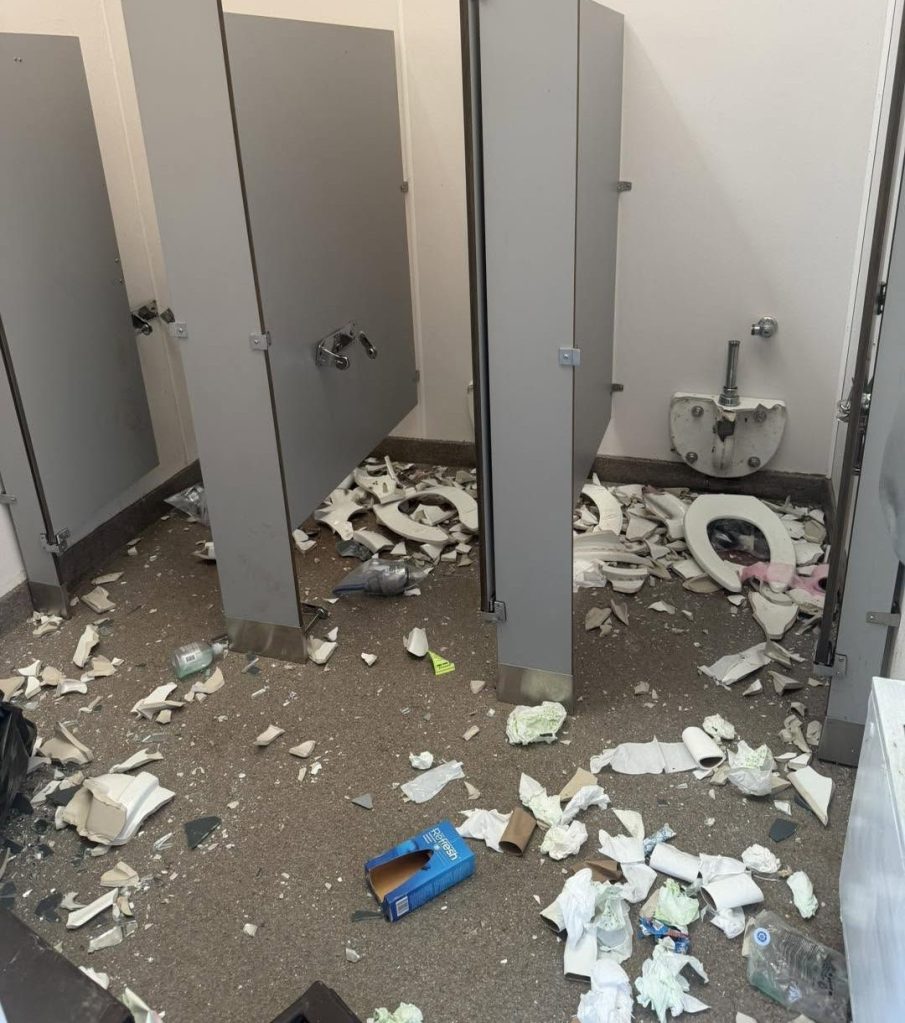
SOUTHBURY — Last winter, vandals caused more than $55,000 in damage across two town parks, Settlers and Ballantine.
The investigation, according to Southbury Police Chief Christopher Grillo, is closed. No arrests were made.
Whether a network of license plate reader cameras would have acted as a deterrent or delivered a different outcome, Chief Grillo is careful not to say.
When the town began evaluating security improvements for the town parks in the aftermath, license plate readers (LPRs) entered the conversation with an intended scope that expanded well beyond the parks.
Now, the town is considering whether to join a growing network of LPR systems across the region via Flock Safety, an Atlanta-based public safety technology company.
The Flock camera proposal sat before the Board of Selectmen at its June 4 and June 18 meetings, resulting in a majority of the board voting to advance the measure, though not before extended questioning of Flock representatives and Grillo at both meetings.
The Board of Finance will take up the funding question at its next meeting on Monday, June 29. If approved, the two-year contract is expected to be returned to the Board of Selectmen for final action.
How the System Works
Flock cameras, at their most basic level, start by taking a photo of every vehicle that passes them.
From that picture, the system extracts visible data points about the individual car, including its make, model, color, and any distinguishing features like bumper stickers or visible damage. That information is processed and temporarily stored through Flock’s software platform. Law enforcement officers are able to search through the data when there is a relevant cause to do so, such as ongoing criminal investigations or a missing person’s report.
The system is not connected to speed enforcement and does not use facial recognition, according to Flock account executive Joe DiStefano.
Officers are able to receive real-time alerts when a vehicle matches databases of stolen vehicles and vehicles connected to missing persons and other serious crimes.
Flock cameras are already deployed by more than 47 law enforcement agencies across Connecticut, including neighboring Newtown, Westport, Wilton, Southington, and Glastonbury, among others.
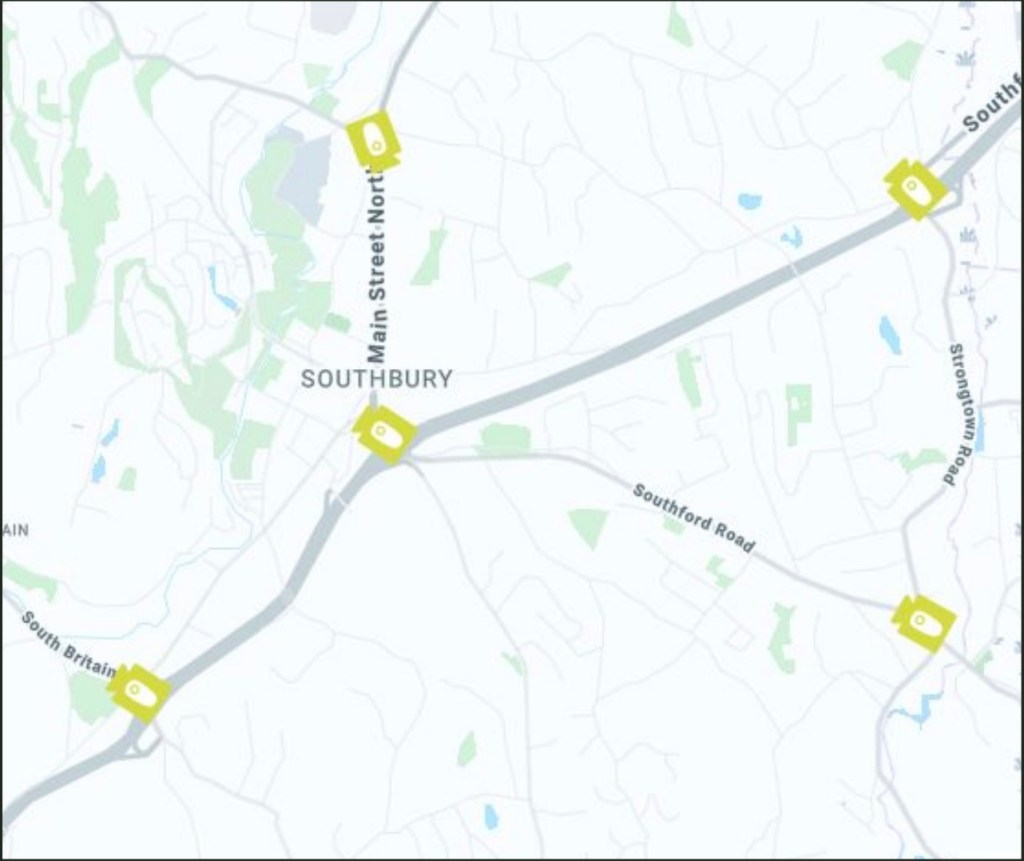
The proposal before town officials calls for the deployment of five automated LPR cameras positioned at town entry and exit corridors under a 24-month contract totaling $42,500.
The five proposed camera locations include Roxbury Road at Route 6; Route 172 at Main Street South; Southford Road (Route 67) at Strongtown Road (Route 188); Strongtown Road at Old Waterbury Road; and Route 6 at Bullet Hill Brook.
Grillo told the Board of Selectmen at their June 4 meeting, “We discussed how it would be a benefit to the park, but it would be more beneficial if these were deployed throughout the town so we could actually utilize them in the manner that they’re supposed to be used for and get more widespread coverage and more of a benefit to the entire town.”
“A Force Multiplier”
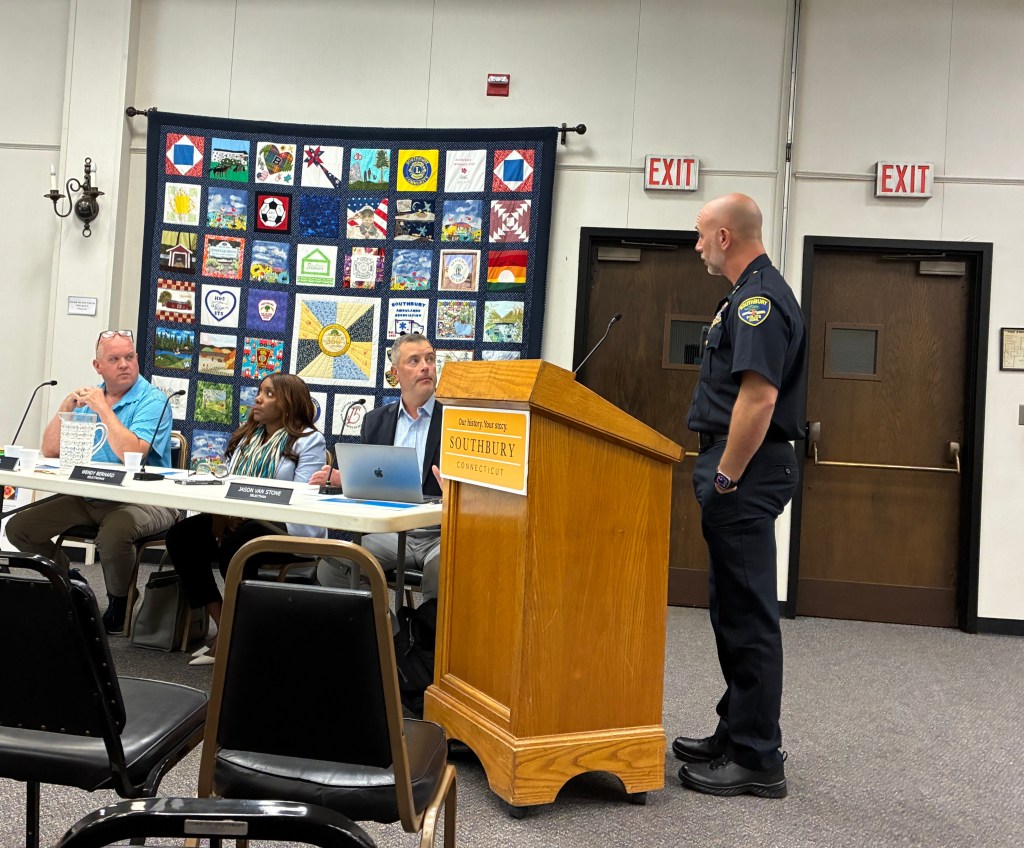
With 26 officers covering a town split by Interstate 84 – and its accompanying three exits – there are still some limitations the Southbury Police Department (SPD) faces, said Grillo. The department is about a year and a half into its life as a fully independent force.
In the first five months of 2026, the SPD has had three missing persons cases, three stolen motor vehicles, and 42 larcenies – 19 of which have taken place at the Southbury Plaza, according to Grillo.
“We can’t be everywhere at one time,” Grillo told the board. “Leveraging technology to aid in the investigation of crimes, investigation of finding people, is important.”
Grillo also noted that the department operates under a statewide non-pursuit policy, meaning that when a property crime occurs, officers do not chase a suspect vehicle leaving the scene.
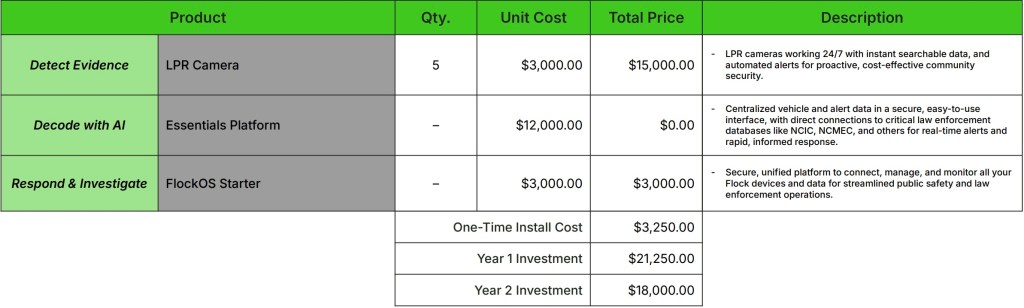
The underlying technology of LPRs is not entirely new to the department, however. Grillo said that a mobile license plate reader mounted to a patrol vehicle has been a part of the force for over a decade.
“The only difference is instead of the car driving around with the LPR, it’s a fixed LPR at targeted points,” said Grillo of the proposed safety plan.
He also pointed to a nearby case out of Newtown, where a Silver Alert for a missing senior was able to be solved using the deployed Flock cameras.
“We have so many elderly in Southbury that this could be useful one day,” said Grillo.
First Selectman Tim O’Neil echoed that point, noting that it could be helpful in locating people suffering from Alzheimer’s or dementia.
Privacy and Tech Concerns
The extended questioning at both meetings raised concerns regarding resident privacy and how the collected data is handled.
Selectwoman Kelly Keenan raised questions about the accuracy of the technology, as well as data security.
DiStefano told the board that the system is built for around-the-clock operation, with the ability to return a confidence threshold for any potential vehicle matches.
Selectman Holly Sullivan’s concerns are aimed at the use of artificial intelligence (AI) within the Flock system and whether residents living near the proposed camera locations have been or will be notified.
She drew on the American Civil Liberties Union’s (ACLU) ongoing campaign against the deployment of Flock cameras in Connecticut and across the nation.
“I’m very concerned about the use of AI by Flock and how that would affect our residents,” said Sullivan, noting that she had read into the concerns online. “People are citing that it does go deeper than maybe what some of the departments signed up for.”
She described the direction as an “Orwellian” world, where cameras are increasingly and constantly recording.
“I think for the average person [who] doesn’t live near one, you pass it here or there,” Sullivan added. “But for the people [who] live immediately around it, the AI is apparently understanding what their daily habits are like and when their daily habits change, and that’s a bit concerning.”
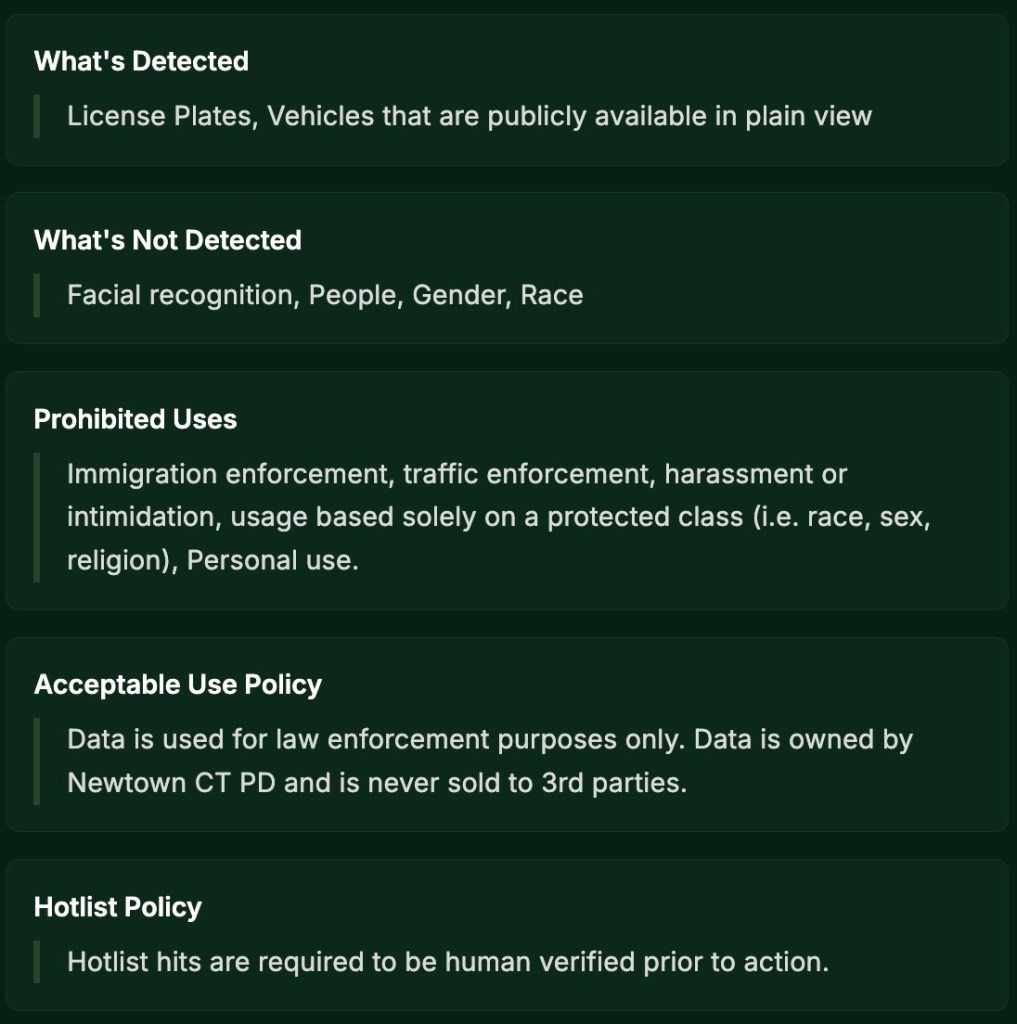
Flock’s Chief of Staff for External Affairs, Holly Beilin, pointed to the regulatory framework in the state that places restrictions on the data collection system.
“It’s kind of the classic case of regulation not being caught up to technology as it could be,” said Beilin, who also has a relative in Heritage Village.
She referenced state law that will require data to be purged after 21 days, and how an audit trail is in place to view what has been searched for within the system. Each municipality also has its own “transparency portal” which publishes policies and usage metrics.
Among some of the state’s key guardrails in place are explicit prohibitions on using the technology for immigration enforcement or to track individuals seeking reproductive or gender-affirming health care. The restrictions also limit the collected data to be shared with agencies only in Connecticut, New York, Rhode Island, and Massachusetts.
Grillo acknowledged Sullivan’s concerns while noting that the potential for misuse already exists.
“It’s a felony to misuse that criminal justice information,” said Grillo. “Officers can and have been arrested – not in Southbury, but at other agencies – for misusing that system.”
What’s Next
The proposal moves to the Board of Finance, which is slated to consider funding the two-year, $42,500 contract at its next meeting on Monday, June 29.
Southbury would join dozens of local governments across the state if the project receives final approval. The Board of Selectmen’s next scheduled meeting is Thursday, July 16.
By Evan Triantafilidis