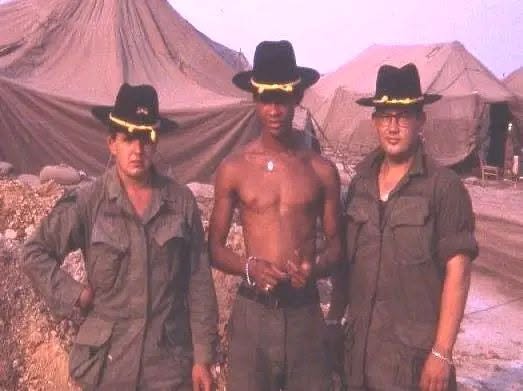
Vietnam veteran Ken McIntosh (center) during his military service. His daughter, Southbury resident Lisa Antrum, says her father’s journey inspired the creation of the annual “Listen to Our Veterans’ Voices” event. (Contributed photo)
Lisa Antrum booked a plane ticket to Florida and made her father a doctor’s appointment before she left. Her father, Ken McIntosh, canceled it the day before she arrived.
She had almost not gone at all. Her sister had been telling her for weeks that she needed to check on their father, and she went, in her words, begrudgingly.
When she arrived, the 6-foot-1 man who raised her weighed under 100 pounds. The house around him was in bad shape, and it was heading toward foreclosure. He had a 12-millimeter patch of what she now knows was skin cancer on his head. He had shut out anyone who had tried to help.
McIntosh came to the United States at 19 as a resident alien from Trinidad and volunteered to serve in Vietnam. In 1968, he was an E-4 air mechanic and a door gunner, earning his citizenship serving a country that wasn’t fully his yet.
On that visit to see him in December 2023, Antrum recalls, “I did not recognize the strong man who raised me.”
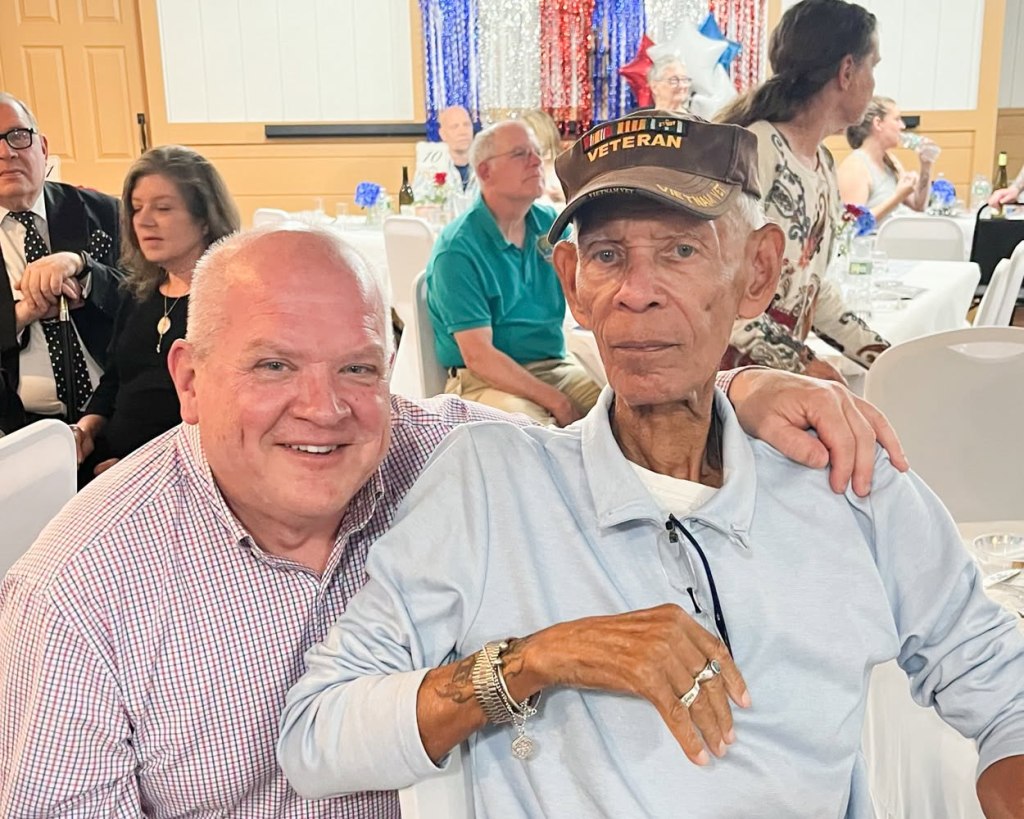
“I thought our government took better care of our veterans than they do,” said Antrum, a Southbury resident.
Finding a Way Forward
From there, Antrum set out to get her father the help he needed. She brought a copy of her father’s original DD-214 (official discharge papers) to a Veterans Affairs (VA) clinic in Brooksville, where she was initially told that her father did not exist, at least not in their system.
She returned the following day with her father and the original discharge paperwork he had somehow held onto for over 50 years. This time, the clinic was able to locate him in their system after digging through records.
What followed was a years-long effort to secure additional VA disability benefits. Doctors documented that his skin cancer and a form of Parkinson’s were consistent with Agent Orange exposure, but his claims were denied.
The VA recognizes certain cancers and other illnesses as “presumptive conditions” connected to Agent Orange exposure, meaning veterans who meet certain service requirements do not need to prove a direct link between their illness and exposure. Eligibility, however, is determined based on the facts of each veteran’s claim. The VA did not provide a response by publication time to questions about how claims involving conditions associated with Agent Orange exposure are evaluated.
Antrum later learned that McIntosh also suffered from depression and that there had been attempts to take his own life.
“My dad survived three helicopter crashes, and getting to know him on a level of what he did in the service, I see why he was the way he was,” says Antrum.
McIntosh, now 81, currently has an 80% VA service-connected disability rating for PTSD and back injuries, but Lisa is still pushing for 100%, saying his Parkinson’s has progressed to affect his vocal cords and, combined with his deteriorating teeth, has made swallowing a choking hazard.
According to the most recent annual Congressionally-mandated report on National Veterans Suicide Prevention, 61% of veterans who died by suicide in 2023 were not receiving VA health care in the last year of their lives.
“It’s Not Okay”
Ken isn’t alone in the wait.
While the average wait for the VA to process a disability claim and make a decision is about 71 days, according to the VA, some formal appeals and complex cases can take multiple years.
In asking other local veterans how long it took them to get their service-related benefits approved, Antrum would often get the response of five, 10, and sometimes 15 years.
“It’s not okay,” she said. “Our government needs to think about when these young people go into war, but also when they come back.”
She recalls her father telling her about his own time at war, where he earned four oak leaf clusters – signifying repeated honors given to veterans.
“You’re taught to kill, kill, kill,” he has told her. “And then one day, they say, you can’t kill anymore.”
What happens to a person after that, he asks her, and what is he supposed to do with it?
In the struggle to get the care he needs, he ponders, “Why did I get all of these medals?”
A Veterans Benefits Administration legal administrative specialist who spoke with The Record said delays often occur when the agency must obtain medical records or other documentation from outside providers, and noted that appeals can, in some cases, take years to resolve.
Listen to Our Veterans’ Voices
Everything that Antrum has learned along the way about how long it takes veterans to get the help they’ve earned has led her to start the “Listen to Our Veterans’ Voices” event and fundraiser.
This June marked the third annual event, held at the George Newton VFW Post 1607 in Southbury, drawing local veterans, community members, and elected officials for an evening of dinner, live entertainment, and conversation.
She is deliberate about what the event’s mission is: to raise awareness and to provide immediate help for a local veteran in need. Elected officials are invited, she says, not for a photo opportunity, but to sit in the room and listen to what veterans in their own community are dealing with, decades after their service ended.
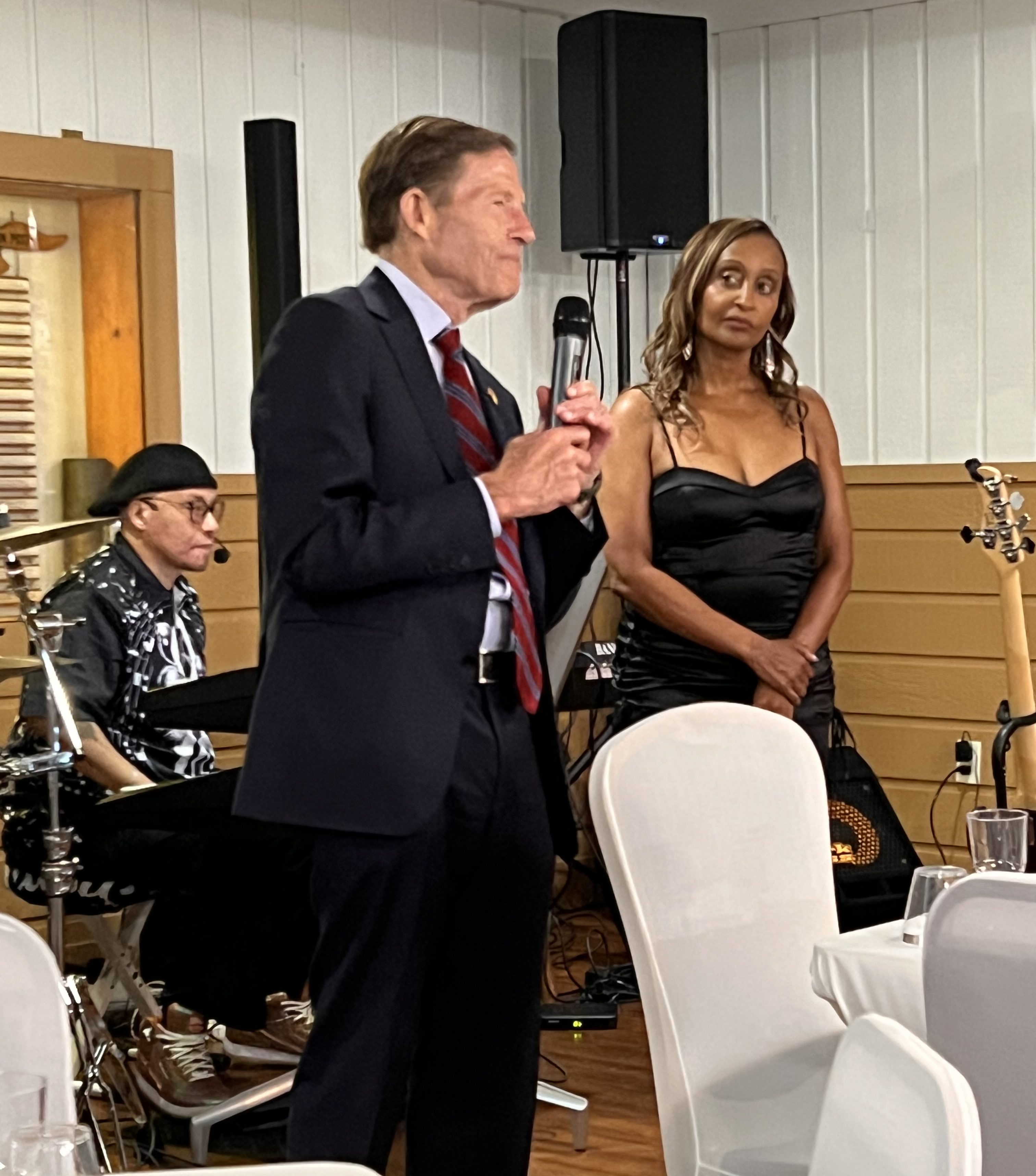
This year’s event drew several elected officials and public leaders, including U.S. Sen. Richard Blumenthal, Southbury First Selectman Tim O’Neil, Selectwoman and veteran Wendy Bernard, Naugatuck Mayor Pete Hess, former Bethel First Selectman Matt Knickerbocker, and state Rep. Josh Elliott.
A portion of the funds raised each year goes to Mission 22, a national organization that works to prevent veteran suicide. A portion of last year’s proceeds went to the widow of a local veteran who died by suicide.

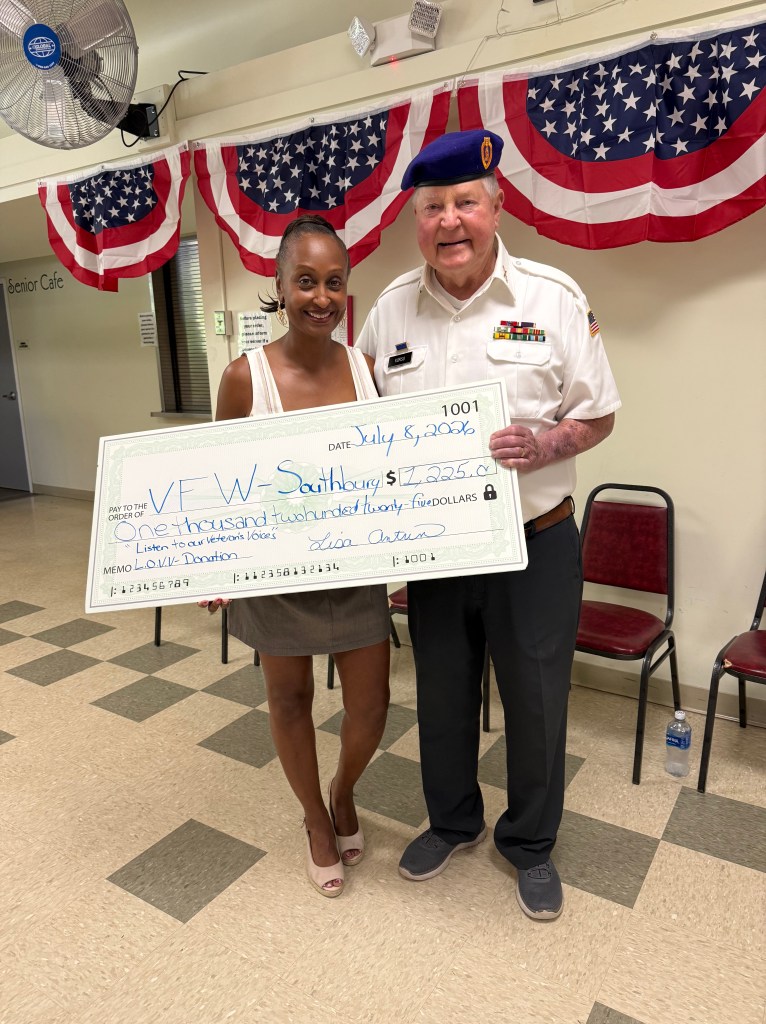
This year, funds were raised for Domenic Guiliano, a local veteran and the State Adjutant and Quartermaster for the VFW Department of Connecticut, whose home was severely damaged in a house fire in January.
It’s a pattern Antrum has come to recognize in those who carry a struggle, but are reluctant to say it out loud, even to the people closest to them. It’s the same instinct, she said, that kept her own father isolated in Florida before she stepped in.
Nearly three years after traveling to Florida in late 2023, Antrum says her father is doing better. The foreclosure was resolved, and he has spoken to his daughter about things he never had before. He still lives with the side effects of a stroke, a form of Parkinson’s linked to Agent Orange exposure, and PTSD from a war that still sticks with him some 60 years later.
For Antrum, the short-term goals of the event provide immediate aid to local veterans, while the long-term goals, she hopes, will spur meaningful change at a higher level.
“Something has to fundamentally change,” she said. “My goal is to be as loud as I can until people know and ask why this is happening.”
If you or someone you know is struggling, the 988 Suicide & Crisis Lifeline is available 24/7 by call or text at 988.
By Evan Triantafilidis


 The Southbury Record