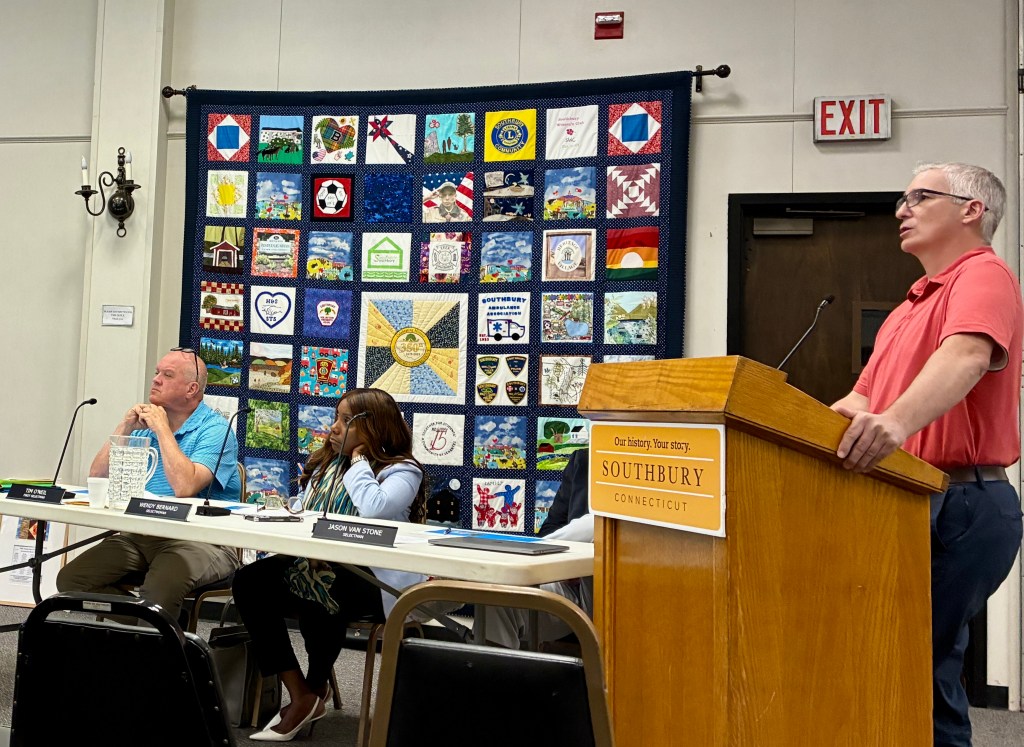
Southbury’s Information Technology Director recently presented the results of a comprehensive audit of the town’s technology systems to the Board of Selectmen, outlining the need to update aging infrastructure within Town Hall and other municipal buildings.
Matthew Zinzi, who joined the town in February, laid out a priority list of upgrades while detailing cost-saving measures that would improve reliability and cybersecurity within town operations, including the Southbury Police Department.
Zinzi’s presentation at the June 18 Board of Selectmen meeting was streamed live on the town’s YouTube channel, though playback of the meeting features intermittent skipping of his talk, unintentionally proving his point.
Server Infrastructure
Zinzi’s top priority, he said, is replacing the town’s server infrastructure, which provides network connectivity, internet access, file storage, and some critical applications for both Town Hall and the Police Department.
Currently, the server cabinet serving Town Hall is housed inside the Finance Department, a practice he says he hasn’t seen before and one that lacks proper power protection.
The majority of the server hardware is over eight years old, he said, with the software running on it being at least 12 years old.
“I don’t want to sugarcoat it,” said Zinzi. “It’s definitely not in great shape.”
Aging Equipment
Zinzi’s assessment also found that about 90 percent of employee computers are more than eight years old, often out of warranty, and running software that no longer receives security upgrades.
The Town Hall network, which also covers Public Works, the Senior Center, and the Animal Control building, runs on roughly 100 user accounts, 125 email mailboxes, and 80 workstations.
“If you ask any one of the employees, they’ll tell you that’s pretty much been the number one concern, is the computers themselves are extremely old,” Zinzi said.
Zinzi noted that his assessment did not include the Southbury Public Library, where much of the technology was recently replaced following the August 2024 floods.
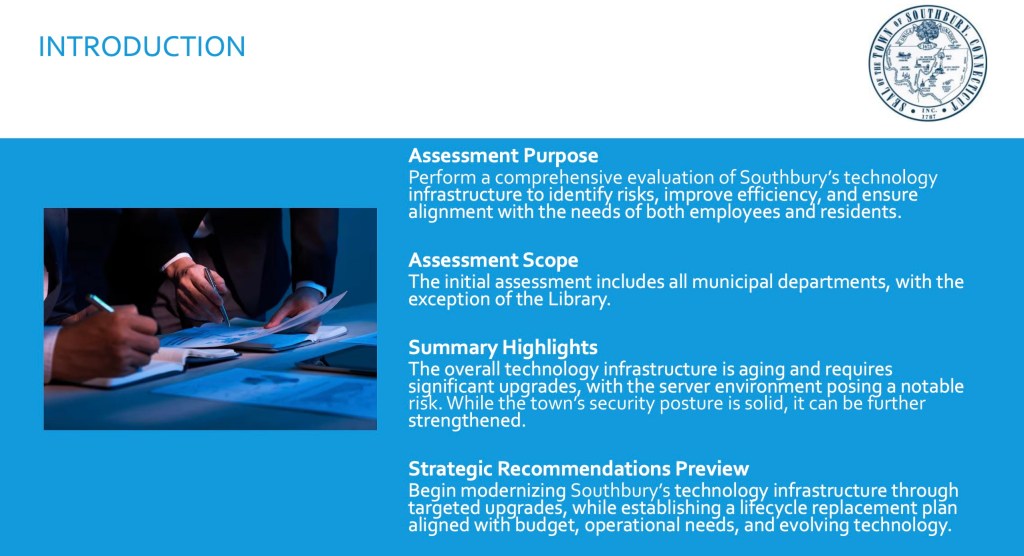
He also stressed that the applications utilized by town employees, like Microsoft Office 2016, are an area he wants to modernize with the latest version, which includes updated collaboration and cloud-based features.
At the Police Department, he spoke of a recent situation where one of the dispatch computers died. The dispatch computers run 24/7 and are slightly older than those at Town Hall, he said.
“It’s 10 years old, so that makes sense,” Zinzi said. “We’ve gotten our money’s worth out of it, that’s for sure.”
For the phone system within Town Hall, a transition to voice-over-IP phones in recent years brought a sense of modernization, but Zinzi said that the process was not fully implemented to its best capabilities.
“Usually, when that’s done, it’s done in a modern way where you connect phones using the same network cables that you connect a computer to,” Zinzi stated. “Unfortunately, that wasn’t done.”
Although the phones are modern, they rely on 50-year-old wiring installed when the building was originally built, resulting in downed phone lines during storms.
Some issues come with relatively easy fixes, he said, with some already underway.
Cost-Saving Opportunities
In his quest to further bring Southbury’s technology into the 21st century, Zinzi said that the town is consolidating five separate AT&T accounts into a single T-Mobile account, with new iPhones and iPads issued at no cost and with connectivity upgrades to 5G from an older LTE network.
He noted that some lines were being paid for months after they were no longer in use, and that going forward, a mobile device management system would be used to track devices.
Zinzi’s audit found an opportunity to reduce software licenses from about 170 users to 100, which could generate savings and the reallocation of those funds for more modern Microsoft licensing.
Some cybersecurity upgrades include an anticipated migration to an upgraded network firewall and the removal of licenses and active technology accounts left behind from former town employees, some of whom left Town Hall eight or nine years ago. The lack of formal onboarding and offboarding procedures, he said, meant that some accounts were still being paid for years after employees departed.
“We’re going to eliminate products that were not used in any way, and use a different product that is not only better, it’s going to be cheaper,” said Zinzi.
Looking Ahead
Asked about the town’s financial position heading into a technology infrastructure overhaul, Zinzi said that the town is in a good position, but time is of the essence.
“I think we have the benefit that a lot of this stuff hasn’t been done for a long time,” he said. “Not that we haven’t spent the money in IT, but I think it’s been spent in the wrong areas.”
Across the board, technology vendors report price increases in the range of 35 to 40 percent, he added before saying, “the sooner, the better on the server side.”
A long-term goal would be to establish a five-to-seven-year technology lifecycle plan, which, he added, is an industry standard.
“When you don’t have that lifecycle, you end up putting things aside and it ends up costing you more money in the end,” Zinzi said.
First Selectman Tim O’Neil said that the findings underscore the impact of deferred technology maintenance and the need for strategic investment.
“Through improved management practices, vendor consolidation, and infrastructure modernization, Southbury has an opportunity to improve municipal services while reducing costs and better protecting taxpayer resources,” said O’Neil.
By Evan Triantafilidis