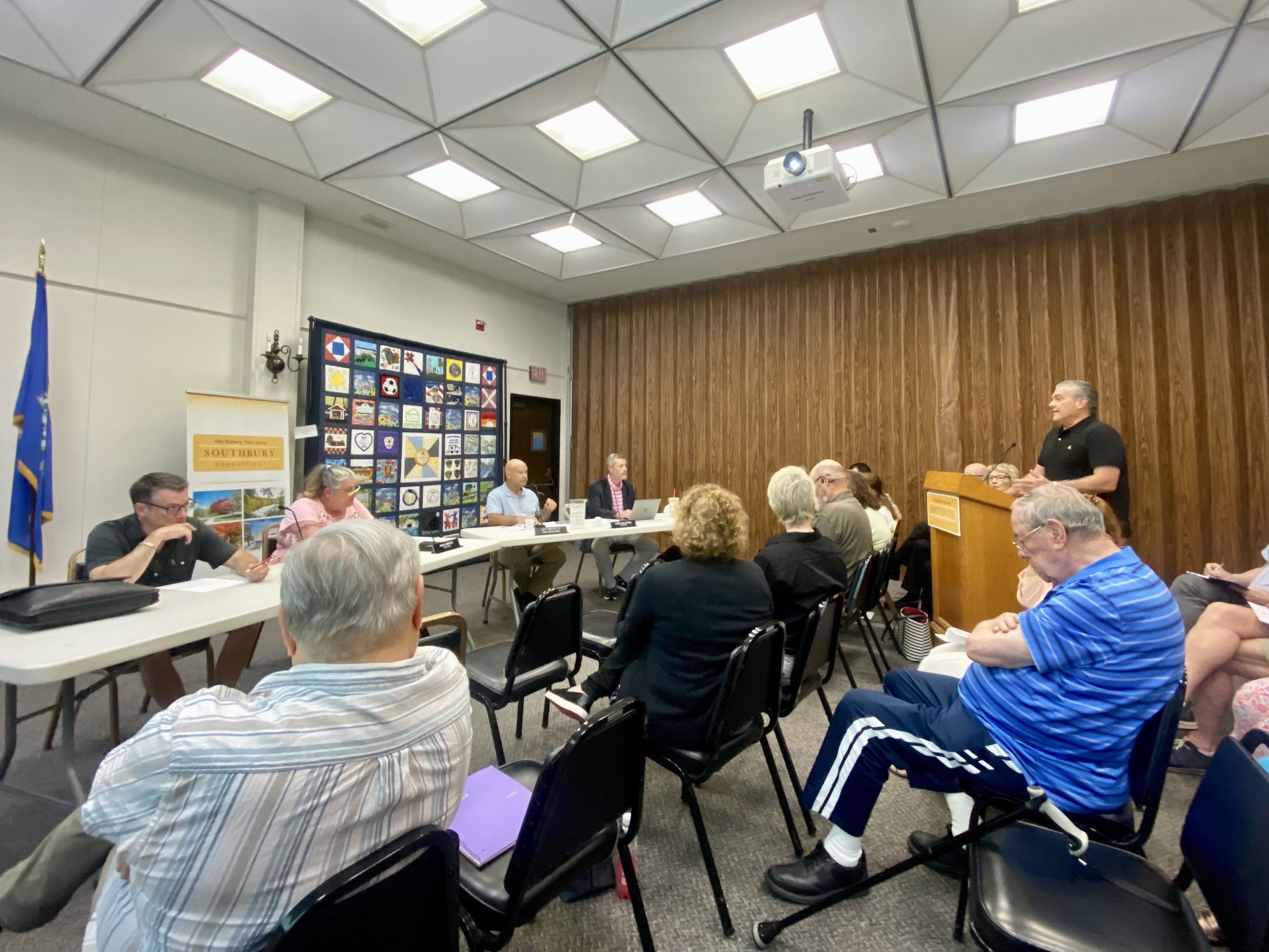
Southbury residents gathered Tuesday night for a public hearing on proposed revisions to the town’s Charter, with several key changes on the table, including extending the First Selectman’s term and merging the Planning and Zoning Commissions.
The hearing, hosted by the Board of Selectmen, marked a critical step in the Charter Revision Committee’s (CRC) year-long effort to update the foundational rules that guide town governance.
The revisions, if approved by the board and passed by voters in November, could significantly reshape local leadership, budgeting and land use policy. The comments made were addressed to the Board of Selectmen, who took in the information but were unable to respond directly in the public hearing.
Selectmen Holly Sullivan and Tim O’Neil were not in attendance for Tuesday’s public hearing.
Over two dozen people packed room 205A at Town Hall, lending their comments on the proposed changes, with the potential merger of the Planning and Zoning boards being the most contentious item discussed.
Richard Teardo, Chairman of the Planning Commission, said discussions have occurred in the past about a potential merger of the boards, but never came to fruition. He pushed back on the idea of combining the two boards, noting that it would be difficult to bring current members up to speed about zoning regulations.
As a member of the Planning Commission for 13 years, Teardo described the commission as a “well-oiled machine.”
“I think joining the two commissions together, in my eyes, will cause a lot of friction and not cause efficiency for the town folks when we look at applications for zoning and planning together,” said Teardo.
Other members of the Planning Commission including Nancy Clark, Robyn Greenspan and Robert Harrison echoed Teardo’s remarks.
“The expertise, focus, and experience and regulations are very different and can be contrary and confusing,” said Clark, noting that meetings with combined commissions in other towns have lengthy meetings that sometimes extend into the late hours of the night.
Harrison said he was concerned about the possibility of losing members of each committee who volunteer their time to hold bi-weekly meetings.
“I would just hate to see people get so frustrated to the point where we start losing even more members,” said Harrison. “I know we’ve got holes in our communities now, and I’m just worried that if we make this process so difficult for our volunteers, we won’t be a town run by volunteers anymore.”
Greenspan shared that the time and commitment to being a member of the Planning Commission had its own learning curve, and that it could affect the volunteership that makes up the boards.
“I echo all the reasons that my fellow commissioners shared, but from a personal volunteer point of view, this would have been untenable for me and I imagine for other volunteers as well,” said Greenspan.
Members of the Zoning Commission, including alternate members Marty Ludforf and Dominick Fatibene, shared similar concerns and called for a closer inspection to the proposal.
Fatibene added, “Respectfully, what I’m recommending is more pausing…until we actually have the right review and consideration by the town, like we’re doing here with this discussion, but also to share it with the land use department.”
Jordan Marcinko, the town’s Land Use Administrator, was not present at the public hearing, but in an e-mail obtained by The Record addressed to members of both commissions on July 3, 2025, he stated his case for leaving the commissions the way they are.
Marcinko’s e-mail reads: “I am personally of the belief that each commission holds dramatically different roles and functions that support the town in very different ways. It is because of that reason that I believe each commission should be solely focused on their individual charges of Planning or Zoning, rather than trying to wear multiple hats and render decisions on behalf of both Commissions, as opposed to the individual.”
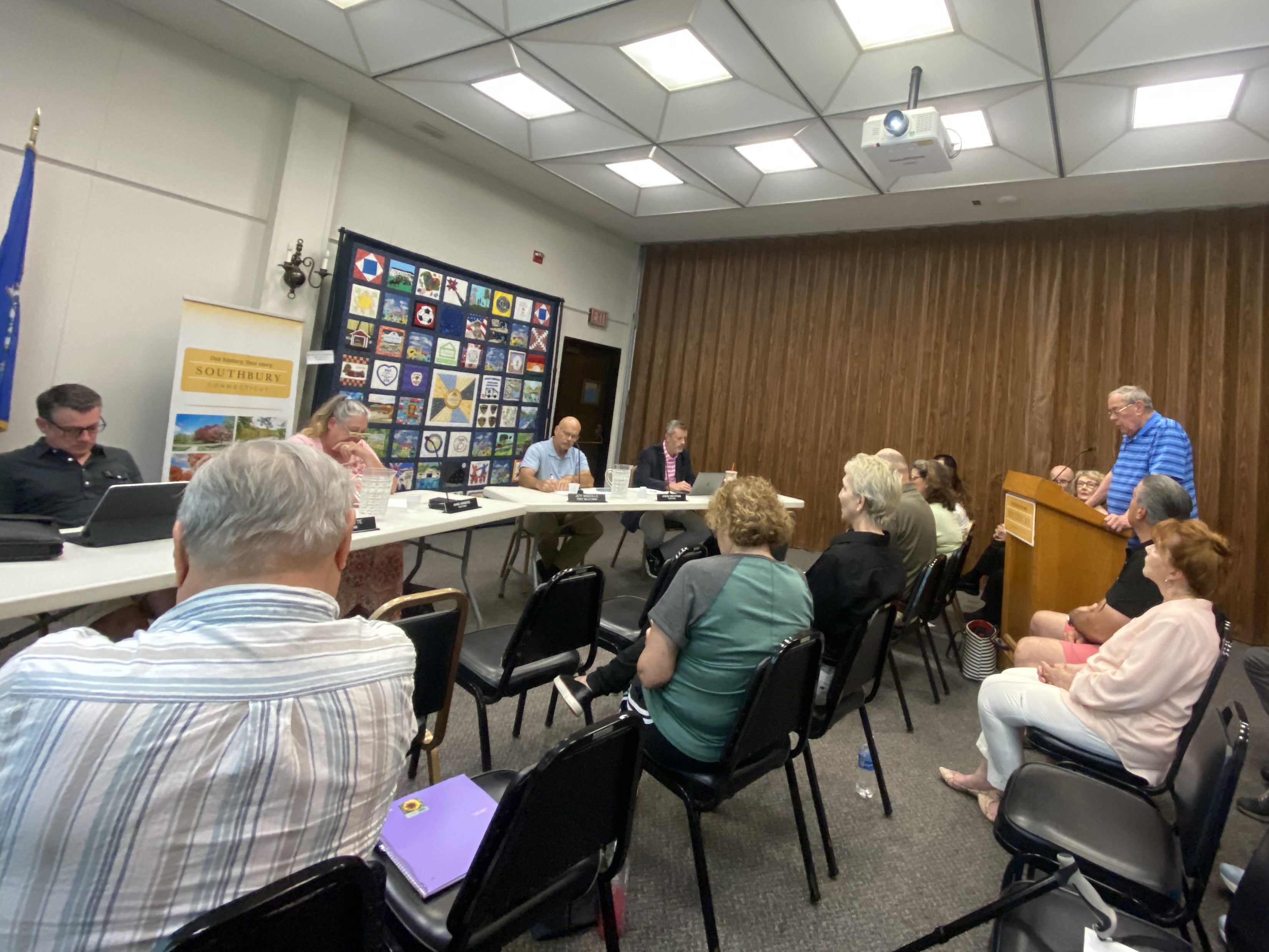
Members of the current CRC were in attendance to give some perspective of how they arrived at this proposed change to the charter.
John Reilly, a CRC member, said that it was not uncommon for residents and applicants appearing before the land use boards to be ping-ponged between them, extending an already lengthy bureaucratic process.
“In talking to the people in the town that come before those boards, the consistent feedback we had was that it is so difficult to get things done in town,” said Reilly. “Having to go before planning, zoning and wetlands and having applications thrown back and forth between those boards and having to pay for lawyers to come in and be there when those boards frequently, because of lack of attendance, cancel their meetings.”
CRC member Michael Carrington echoed Reilly’s remarks, citing the defunding of the town’s economic development director position earlier this year as a detriment to someone wanting to start a business in Southbury.
“We’re not hearing a lot from the small business community that has often complained about how difficult it is to get things started in Southbury,” said Carrington. “I’m not saying we need to deny this, but I think it’s a worthy question to put to the voters, as are all of these things.”
Carrington continued, “And, frankly, if this goes to the ballot, I’m not even sure how I’m going to vote on it, but I do think it’s something I want more information on.”
Members of the Planning Commission rebutted the notion that lengthy land use processes are due to the configuration of the separate boards, saying that a pre-application process was put into place to help guide applicants who come before the land use boards.
In her second time speaking during the public hearing, Clark said, “The reason they have to come back and go back is because they don’t have a complete application nine times out of ten.”
Chairman of the CRC, Joe Ruggiero, said he had reached out to leadership of both land use commissions in the early stages of the charter revision process, but had never received feedback.
He noted that he reached out to the Land Use department in 2024, and had attended a Planning Commission meeting where he asked for input, but feedback wasn’t given then.
“It wasn’t done in a vacuum, and we decided that it was worthy of being put on the ballot, so I’m glad to hear some of the feedback,” Ruggiero stated. “I wish it was sooner.”
Other members of the public raised concerns with the proposed lengthening of the First Selectman’s term from two to four years, inquiring why it would only affect the First Selectman’s term length.
Although members of the Board of Selectmen were unable to directly address their constituents at the public hearing, First Selectman Jeff Manville thanked the public for making their voices heard.
“I appreciate everybody taking their time to address the board on this public hearing,” First Selectman Manville said. “You’re truly addressing not just the board but also the public.”
For a more complete breakdown of the proposed charter changes, visit some of The Record’s previous coverage of the charter revision process.


 The Southbury Record