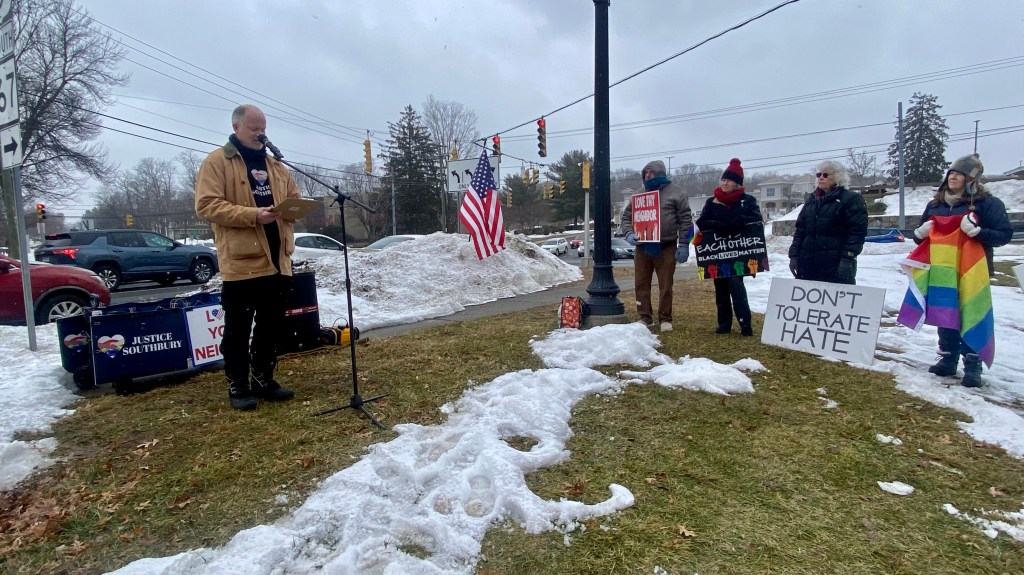
SOUTHBURY – The snow had just begun to fall on Main Street South.
Ahead of a blizzard calling for more than a foot of snow, over 20 people stood at the corner of Main Street South and Route 6, anyway.
They’ve been standing here every Sunday afternoon for over five and a half years.
On this particular Sunday – their 300th – their cardboard signs and heavy jackets caught snowflakes as cars streamed by one of Southbury’s busiest intersections.
Some drivers honked in support, with the group of bundled-up attendees waving back.
A woman rolled down her passenger window as her car slowed approaching a traffic light, taking in the words of speakers calling to “love thy neighbor”, applauding the group as her minivan traveled off in the distance.
A few minutes later, a truck slowed in the middle of the road. The driver leaned out.
“You’re horrible people,” he called out.
The group didn’t flinch; they had heard it before.
This is Justice Southbury – a grassroots social justice initiative born in the grief and urgency of May 2020, following the death of George Floyd. Organized by local volunteers, like co-founder Rick Richardson, the non-partisan and non-religious group collects donations for the local food bank while spreading a simple message: Hate has no home here.
The exchange with passing drivers reflects what 300 straight Sundays have looked like.
“That’s the dichotomy of what we deal with here,” said Richardson.
A Time to Reflect
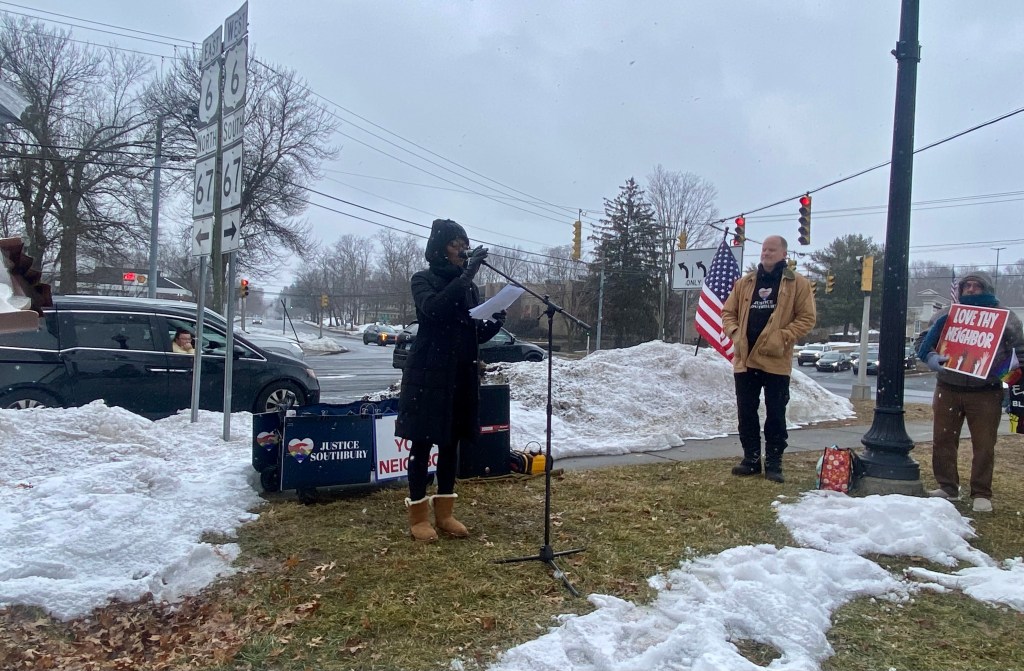
An American flag is planted in a snowbank, surrounded by signs that have weathered seasons far milder than this one. They’ve been planted in the ground through national elections, local arguments, and the grinding passage of American life in a small town in Connecticut.
Richardson reflected on how far the group has come since its inception.
“We believed that it was important to be a consistent presence, a force for good,” Richardson said to the crowd of supporters. “And we never canceled, bowed to pressure, or took a day off.”
Since their first gathering, the group has expanded beyond the corner, hosting virtual speaker series and bringing together community members and local clergy for conversations that most small towns quietly avoid.
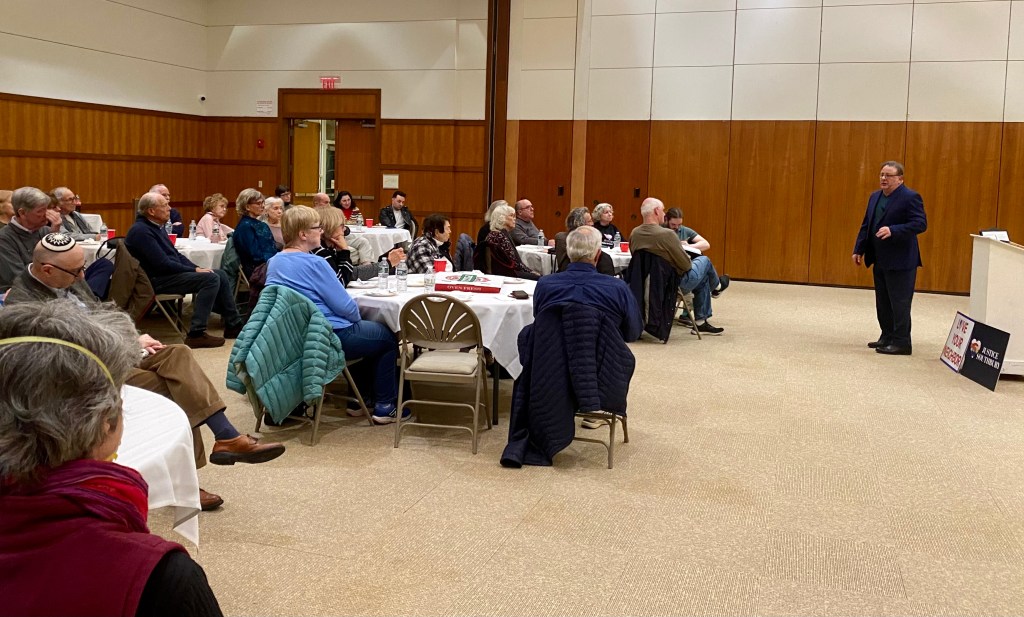
Just last month, the group hosted a community discussion at a local temple aimed at “bridging the divide”, looking into more effective ways to bring about social change. What was expected to be a roundtable discussion with a handful of locals turned into a full house, with nearly 50 people coming together to hear from a local columnist and finding common ground amongst the diverse attendees.
Connie Cole-Ingber, a familiar face within Justice Southbury, remembers how the night unfolded.
The community conversation had wound down into a question-and-answer session when an attendee – a self-described two-time Trump voter – stood up and announced her support for the current administration. It was the same day that a 37-year-old mother of three had been fatally shot in Minneapolis, Minnesota, by Immigration and Customs Enforcement agents, and the room held the weight of that.
But as the group began folding chairs and gathering their things, the same woman turned to Cole-Ingber with a simple, practical question: was she heading her way? Would she drop her off at the local Dunkin’ Donuts for her husband to come pick her up?
It turned out to be right on Cole-Ingber’s route home.
“We bridged our divide that day by providing her a ride home,” Cole-Ingber said the following Sunday.
Finding Common Ground
The group has always been deliberate about its tone: non-partisan, non-religious, inviting even to those who slow their trucks in the middle of a busy intersection to call them horrible people.
Among the signs held on the corner each Sunday, one stands out for its simplicity: “Come Talk To Us.”
It is, in many ways, the entire philosophy in four words.
“It’s the sincerity of what we’re about,” Richardson said. “We’re not religious, but we may talk about religious themes. We’re not political, but we talk about governance and how a country should deal with its citizens.”
That sincerity, he says, is also what gets misread. Passersby make assumptions. They see a group on a corner with signs and fill in the blanks, connecting Justice Southbury to other movements, other agendas, other causes that aren’t theirs to own.
“I really think it’s the sincerity of what we’re doing that people misjudge,” Richardson said. “People think, ‘you must be doing this, or you must be doing that.’ I invite people all the time – if you want to know what we’re doing, come to a rally. If you want to know what we talk about, come and listen.”
“You might think ‘love your neighbor’ is not important, and you don’t share values with me,” Richardson said. “But if you think that’s important, then what does it mean? What does ‘love your neighbor’ mean to this country and this community in 2026? That’s what we’re doing every single week.”

What Comes Next
On Sunday, the group was joined by guest speakers who had made the trip to Southbury despite the incoming storm, a fitting gesture for a milestone built entirely on showing up.
Kathy Taylor, president and CEO of the Connecticut Community Foundation, addressed the crowd with an affirmation of what 300 Sundays actually means in practice.
“300 Sundays is not a moment, it’s a commitment, and it’s a testimony,” Taylor said. “You have created a rhythm of care. You all have shown that justice work is not about big rallies and loud moments. Sometimes, it’s a quiet, steady presence.”
Danbury-based attorney Bob Opotzner also spoke, tying the group’s work to a broader national moment, and pointing to a recent Supreme Court decision on tariffs. By a vote of 6-3, the justices ruled that the tariffs, which were imposed by a series of executive orders, exceeded the powers given to the president by Congress.
Opotzner suggested the decision reflected the influence of sustained civic engagement, using Justice Southbury’s consistency as a model example.
“That vote was, I believe, because of groups like yours,” Opotzner told the crowd.
Justice Southbury co-founder Julia Bower-Richardson closed out the gathering the way Justice Southbury always does, with the group’s signature rally call echoing off the corner of Main Street South into the cold February air.
“Fired up. Ready to go!”
Going forward, the group pledges to engage the community in “difficult conversations during difficult times.”
They’ll be here next Sunday, like they always are. Same corner, same two ‘o’clock hour.
“There are always two choices,” says Richardson. “Do something, or do nothing.”
For 300 Sundays — and counting — they’ve chosen to do something.


 The Southbury Record