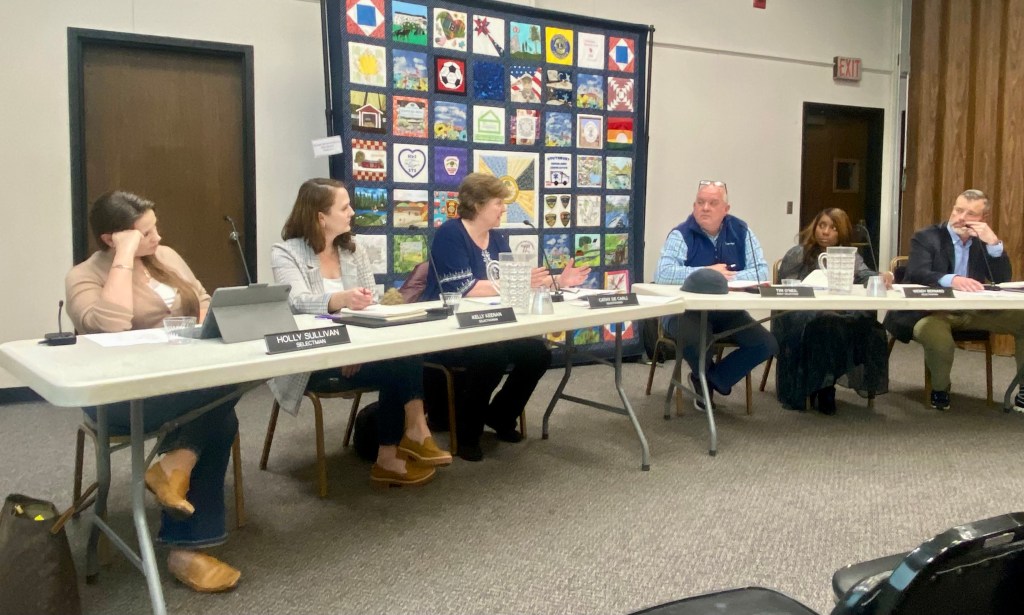
SOUTHBURY – Thursday’s Board of Selectmen meeting included continued discussion on a mix of old and new business, including plans for accepting a state grant aimed at waste reduction, the possible revival of a Strategic Plan Commission, and broader commentary on housing issues facing the town.
In addition to regular board business, the board heard a presentation from Chuck Litty of Sustainable Southbury regarding a Sustainable Materials Management (SMM) recycling grant awarded to the town.
Trash Talk
Litty sought the board’s approval of the grant, which was obtained with assistance from the North Carolina-based WasteZero, Inc., and is intended to support local trash management and waste reduction efforts.
Southbury was one of 18 municipalities and regional organizations statewide to be awarded a portion of $7.5 million in funds last October through the second round of SMM grants, administered by the Connecticut Department of Energy and Environmental Protection (DEEP).
The $157,160 grant promotes the potential implementation of unit-based pricing, or “pay to throw” where residents using the transfer station would pay based on units of trash disposed of.
Litty explained, however, that by accepting the grant, the town is under no obligation to commit to unit-based pricing. The grant is structured in “toll gates”, allowing the town to withdraw from the program with no strings attached.
Broken down, the grant comes in three different phases, where the town can decide to continue with the program or have it come to a halt. The initial phase of groundwork calls for stakeholder and public engagement, with an expected timeline of six months.
“Essentially, we’re being given $17,000 to study if this is a good idea or not,” Litty said of the first step of the grant. “If we choose not to move forward, no harm, no foul.”
The second phase of the grant calls for the largest chunk of grant money to be used on implementation, with $105,000 to coordinate vendors and outreach. The remaining $35,000 of the grant would be used for monitoring and evaluation of the program.
In his presentation, Litty pointed to other towns, such as Woodbury and Stonington, that have seen municipal waste levels drop, in some cases, by more than 50 percent.
Food scraps constitute the largest portion of trash by weight, according to the Environmental Protection Agency. The implementation of unit-based pricing would likely lead to an increase in food scrap collection – an endeavor already being pursued by Sustainable Southbury.
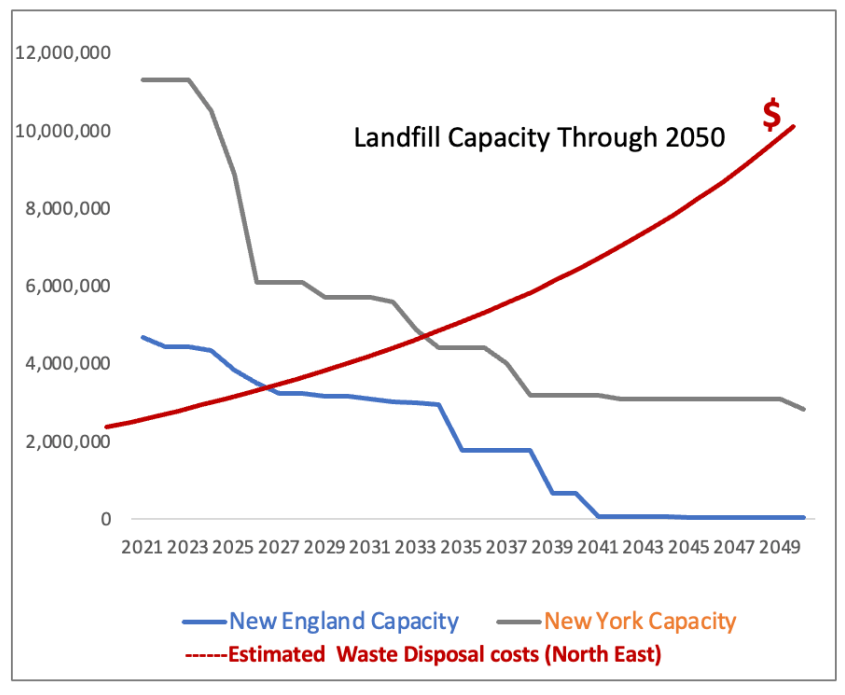
Last November, the Board of Finance gave its blessing to approve the grant when Litty made a similar presentation and further explained how disposal costs are increasing as the number of disposal options are decreasing in the region. Landfill capacity in New England is expected to drop to zero as early as 2041, according to WasteZero.
On Thursday, some members of the Board of Selectmen expressed some initial hesitation to immediately sign off on the idea, including Selectman Jason Van Stone, who noted privacy concerns with the program’s auditing process of trash, as well as potential added costs to residents using the transfer station.
If fully implemented, the program could lead to residents being responsible for purchasing designated color-coded waste bags from local retailers, similar to Woodbury’s program, where an orange-colored 13-gallon garbage bag costs a dollar per bag.
“It might be nominal,” Van Stone said. “Nominal for one family is different for another family.”
While the board unanimously agreed to proceed with the initial groundwork phase, it was clarified that there would be another board vote in about six months to decide whether or not to move forward with further implementation.
Strategic Planning: Commission or Task Force?
The board also entertained the idea of reviving some form of strategic planning body for the town while revisiting the history and challenges of the former Strategic Plan Commission.
Selectmen debated whether any future planning body should take the form of a permanent commission or a short-term task force.
First created as a task force in March 2017 before being elevated to a full commission in February 2019, the former Strategic Plan Commission essentially dissolved due to a lack of membership and reported overlap and disagreements with other town boards.
Meeting minutes from the former commission’s final meeting in December 2024 indicate that several members planned to resign the following month, citing “a lack of engagement from town government over the prior year.”
The ultimate difference between a town commission and a task force is that a commission has more of a permanent effect on town business and policy (Planning Commission, Zoning Commission, etc), rather than a task force, which can be formed for a singular issue (Pool Task Force, ARPA Task Force).
During public comment, Joe Ruggiero urged caution before creating a new standing commission or task force.
“From the start, the intentions were good, but some of the reality of its implementation and function were somewhat different,” Ruggiero said, adding that friction developed over time between the Strategic Plan Commission and other boards, including Planning, Zoning, and Economic Development.
Just two months ago, residents overwhelmingly voted to strike the former commission from the town’s charter, as part of a larger, catch-all omnibus ballot question. The measure passed by a 4,319 to 1,043 vote.
Some members of the board balked at the idea of almost immediately bringing back a commission that voters had effectively erased from the charter.
Ruggiero noted that the concept of strategic planning is still needed for the town, but the execution and structure of said plan is critical to its success.
“I do not think this is a repudiation of strategic planning and thinking by the general voting populace, but acceptance of the current form not working,” said Ruggiero.
Selectman Holly Sullivan, now the longest-serving member of the board since being elected in 2021, acknowledged the past overlap between the former Strategic Plan Commission and the Planning Commission. “I think there are some valid reasons why that went away,” she added.
First Selectman Tim O’Neil indicated that he would support a task force instead of a commission. The board ultimately decided to table the discussion, with a vote expected at a future meeting on whether to pursue a short-term task force or other advisory structure.
GES/PES Properties
In discussing potential sites and long-term plans for Region 15 School District’s two oldest schools, First Selectman O’Neil was asked to explain why a certain piece of property was taken out of consideration.
The Record previously reported that First Selectman O’Neil was “totally against” a potential site at 415 Roxbury Road for the relocation of Pomperaug Elementary School.
O’Neil relayed that in talks with state officials, a proposed site on a portion of the state-owned Southbury Training School (STS) property was discussed, but ultimately withdrawn, saying he was not sure what the state intended to do with it.
Selectman Van Stone referenced the idea behind House Bill (H.B) No. 7281, which allows the Town of Southbury to sell, transfer, or lease a 45-acre parcel of land at STS for housing purposes, under the stipulation that at least 30 percent of the housing units be designated as affordable housing.
In saying so, Van Stone labeled potential future plans as “subsidized housing” and later as “not-market-rate housing”.
Selectwoman Wendy Bernard pushed back on that characterization, saying, “I want to clarify here that when we are talking about affordable housing, it isn’t this sort of subsidized housing project or anything that comes with that sort of derogatory connotation.”
For H.B. 7281, affordable housing is defined as units that must be at a cost where residents do not pay more than 30 percent of their income, with their income being at or below 80 percent of the area or state median income.
O’Neil relayed that in talks with a state official from the Office of Policy & Management, the official had specifically been tasked with affordable housing in Southbury and Hartford.
“Southbury does need affordable housing, and that’s definitely high on our list…getting the personnel village developed,” O’Neil said.
The next Board of Selectmen meeting will be held on Thursday, February 5 at 7:00 p.m.
This was updated mid-day January 16 to reflect the former “Strategic Plan Commission” was created to “monitor the Town’s progress concerning implementation of the Strategic Plan”. The town initially had a Strategic Planning Task Force that completed the town’s Strategic Plan.


 The Southbury Record