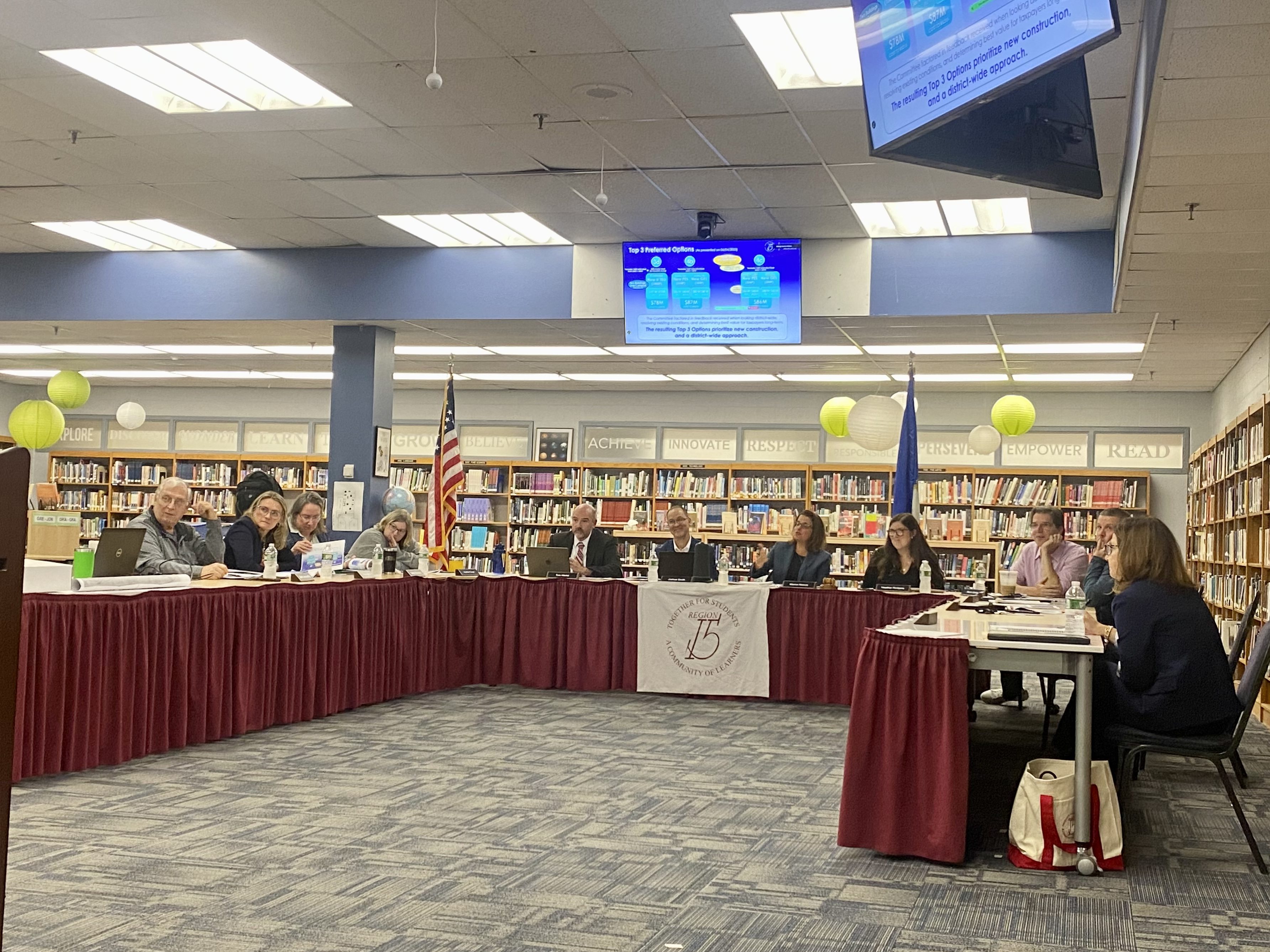
The Region 15 Board of Education is weighing the future of its two oldest schools, Gainfield and Pomperaug Elementary.
Consultants returned to the board this week with updated feasibility findings, more than a year after a study committee began charting possible paths forward.
The committee’s preferred option calls for building a new consolidated school on a separate site — a “two schools, one campus” design — though alternatives remain on the table, including rebuilding on the current footprints.
What’s clear after months of meetings and community conversations is that new construction has risen to the top of the discussion, with a potential referendum as early as next spring to secure local funding.
If a decision is made on a school complex upwards of $175 million, a potential fall 2030 construction completion date awaits future students of Southbury and Middlebury.
And while board members sift through design concepts, land requirements, and state reimbursement deadlines, the urgency is easy to spot inside the schools themselves.
State of Repair
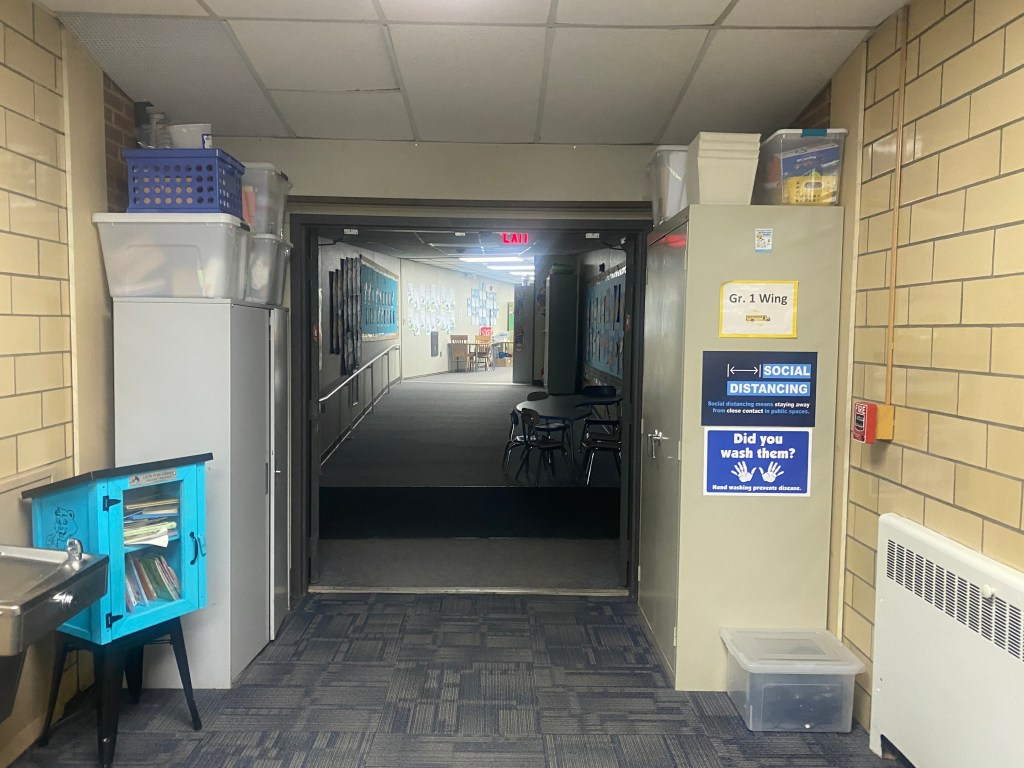
A radiator rumbles in the hallway of Gainfield Elementary School (GES), leading up to the modular classrooms. A lone desk and chair sit pressed against the wall due to a lack of space.
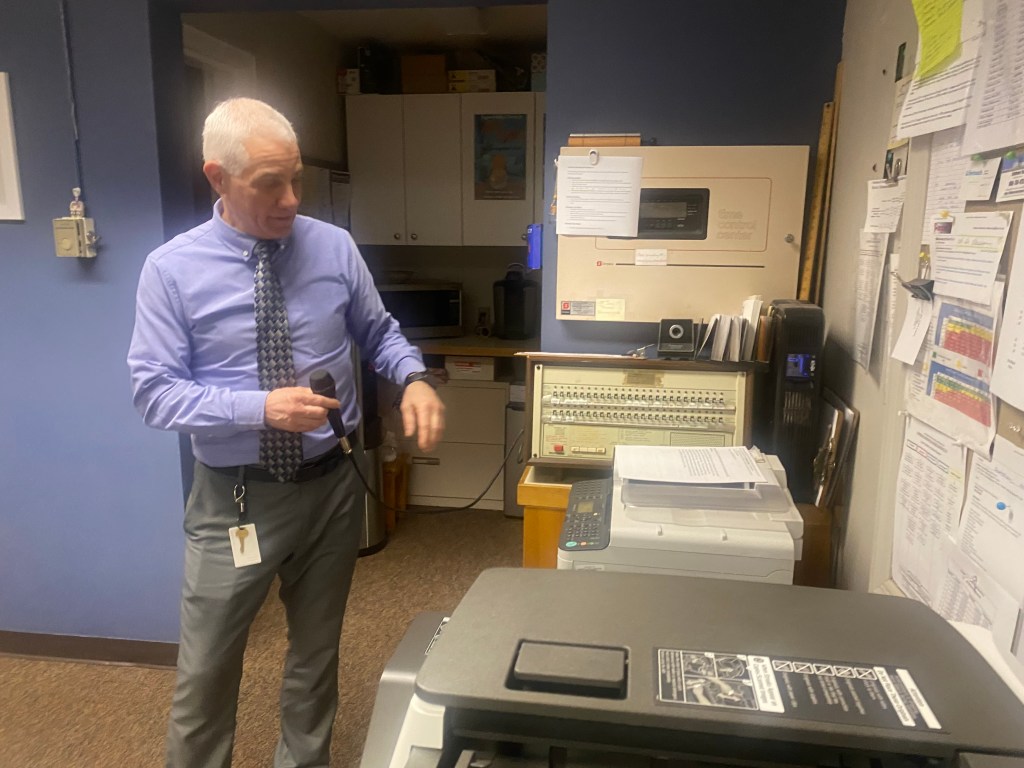
The principal, Jon Romeo, points out the building’s decades-old Bogen PA system, a relic nearly as old as some of the most veteran educators within its walls.
Gainfield opened its doors in January 1942, when it was known as the “Southbury Consolidated School,” and was built to succeed the oldest public building in Southbury, the Bullet Hill School.
Project managers from the contracted Hartford-based Tecton Architects have also pointed out that the school’s gym is too small for two classes at once, and the main office sits tucked away from the front entrance, offering little visibility for secure oversight.
That doesn’t include the closure of a nearby road due to last year’s historic flooding, which has only exacerbated local traffic concerns.
About a mile away on Main Street South, the scene is somewhat similar at Pomperaug Elementary School (PES).
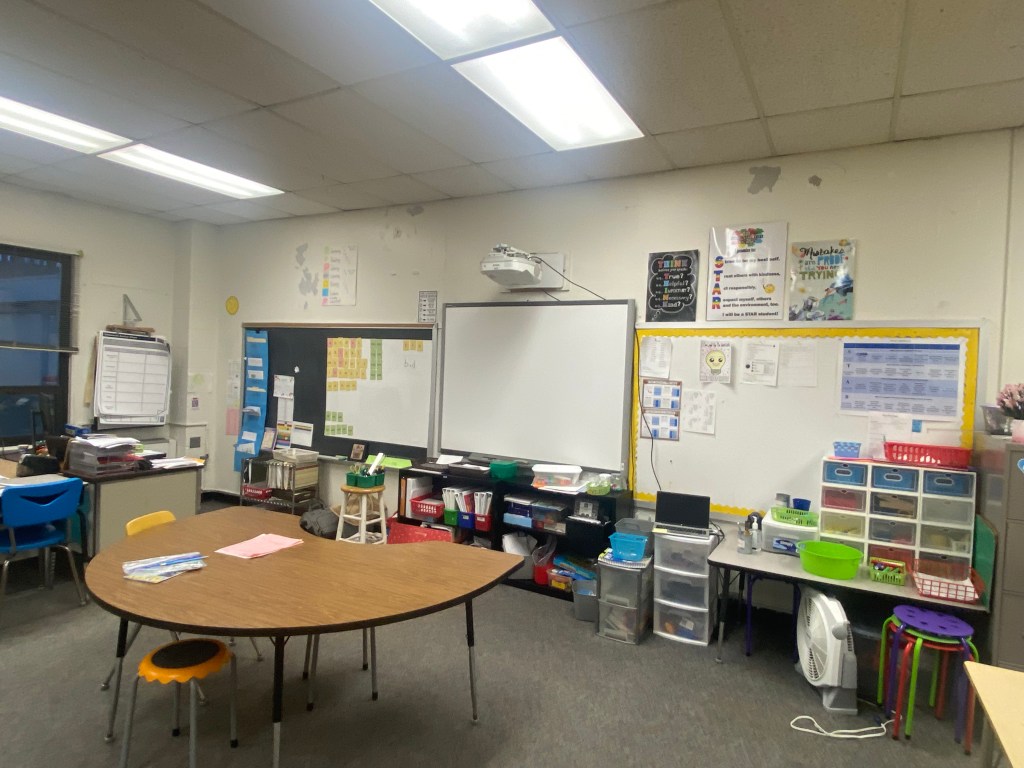
Gym equipment spills into the hallways. Paint peels from the walls above the chalkboards. Traffic backs up daily on Main Street as families queue for drop-off and pick-up.
PES has been in use since 1967, a year prior to the regional school district being officially formed.
Both elementary schools were left out of the district’s repair bond talks from last year, due to the high cost of fixing them. The cost for the roof of PES was quoted in the seven figures, says board chair Marion Manzo.
In June, the board received the official recommendations of the aforementioned feasibility committee, which outlined three different plans – narrowed down from nearly a dozen initial options.
The board stressed that no final decision has been made yet, as more community input and detailed cost estimates are forthcoming.

“Two Schools, One Campus”
The top options were unanimously recommended by the stakeholders who made up the Feasibility Study Committee, including town officials from both towns, educators in both schools, and members of the schools’ Parent-Teacher Organizations.
“Ultimately, after many, many meetings, the Feasibility Study Committee recommended to the Board of Education to build one new school on a new property,” explained Manzo. “If possible, it was going to be two schools, one campus.”
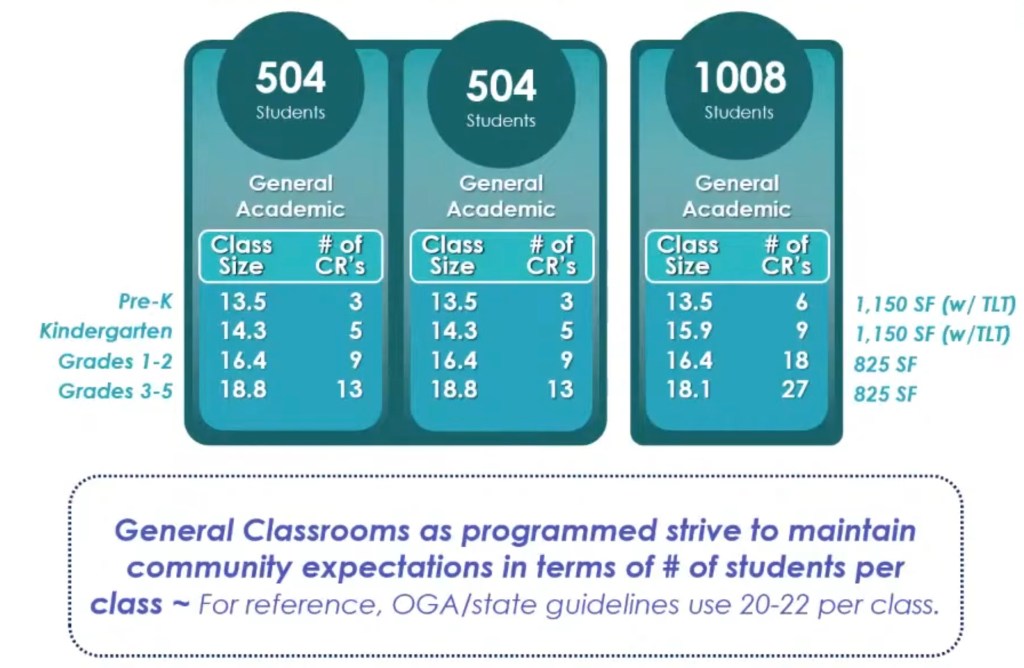
The plan calls for 15 usable acres, and the new school would be able to hold 1,008 students in the grades of PK-2 and 3-5.
A new combined school would feature small learning communities with adjacent support space, a gym and multi-purpose auxiliary gym, as well as two separate cafeterias served by one central kitchen.
Even with a larger footprint, class sizes would be under 19 per classroom for grades 3-5 and just above 16 per classroom in grades 1-2. Kindergarten and Pre-K classroom sizes are projected to be even lower, according to Tecton.
The total project cost of the “combined school” option is estimated at $175 million, with taxpayers paying nearly half the costs after state reimbursement.
The outlined costs do not include the sale or purchase of property, nor the demolition and remediation of PES.
However, the district is looking to introduce a Pre-K program at both schools in order to obtain an additional 15 percent to their reimbursement rate and to ease some capacity concerns at Long Meadow Elementary School in Middlebury.
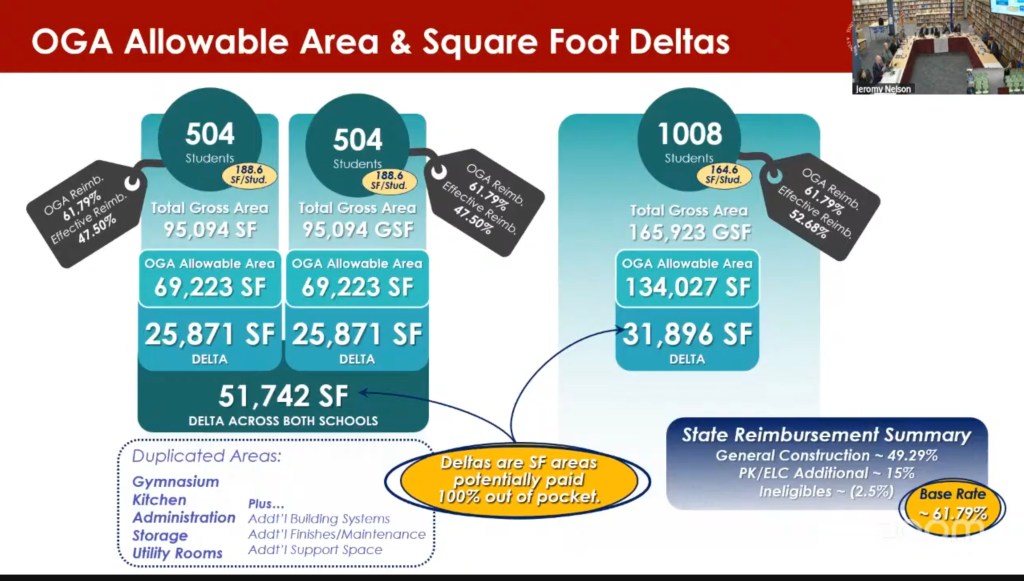
A proposed concept of a 165,000 square-foot combined school would exceed the state’s maximum allowable square footage for new or renovated schools that are eligible for reimbursement based on projected enrollment and grade configuration.
If the district were to build within the state’s reimbursable limits, a maximum reimbursement is possible.
If the design calls for extra space, like the proposed plan, the state won’t automatically cover those costs. Communities can decide if they want to apply for space waivers, which, if granted, would make part of the additional space reimbursable.
With a space waiver, the cost to the school district could drop from approximately $83 million to $66 million. Without the waiver, local taxpayers would shoulder the cost of any additional square footage the state won’t cover.

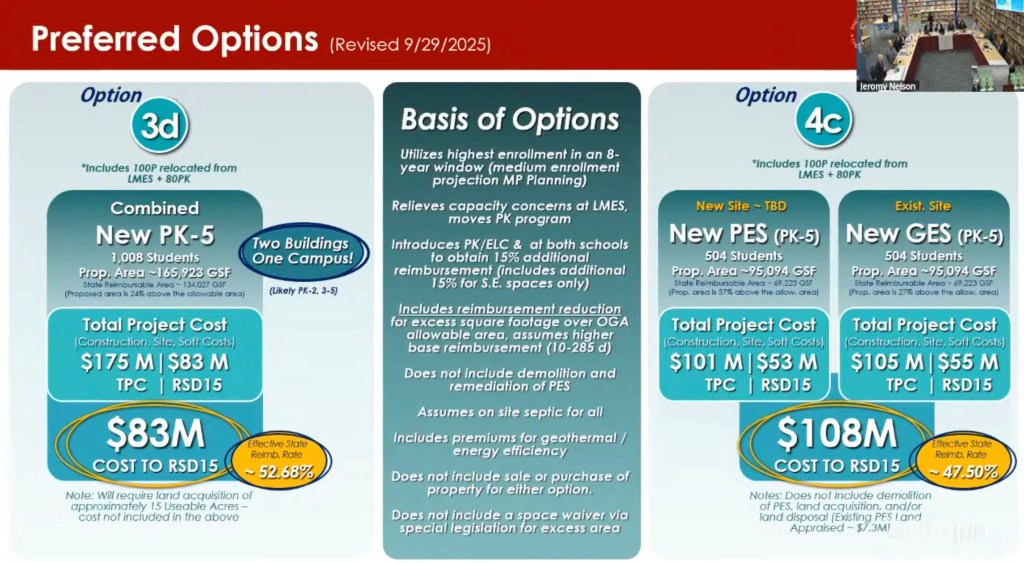
An alternative recommendation includes a plan that would see two new schools built on each of their existing footprints in Southbury.
A third option could bring two newly constructed schools, but it involves relocating PES from its home on Main Street to a new site while GES is built on its existing site.
If two separate schools are built, those buildings would be about 95,000 square feet each, at a total cost of approximately $206 million. The school district would be responsible for roughly $108 million of the cost, which could come down to $78 million with a space waiver.
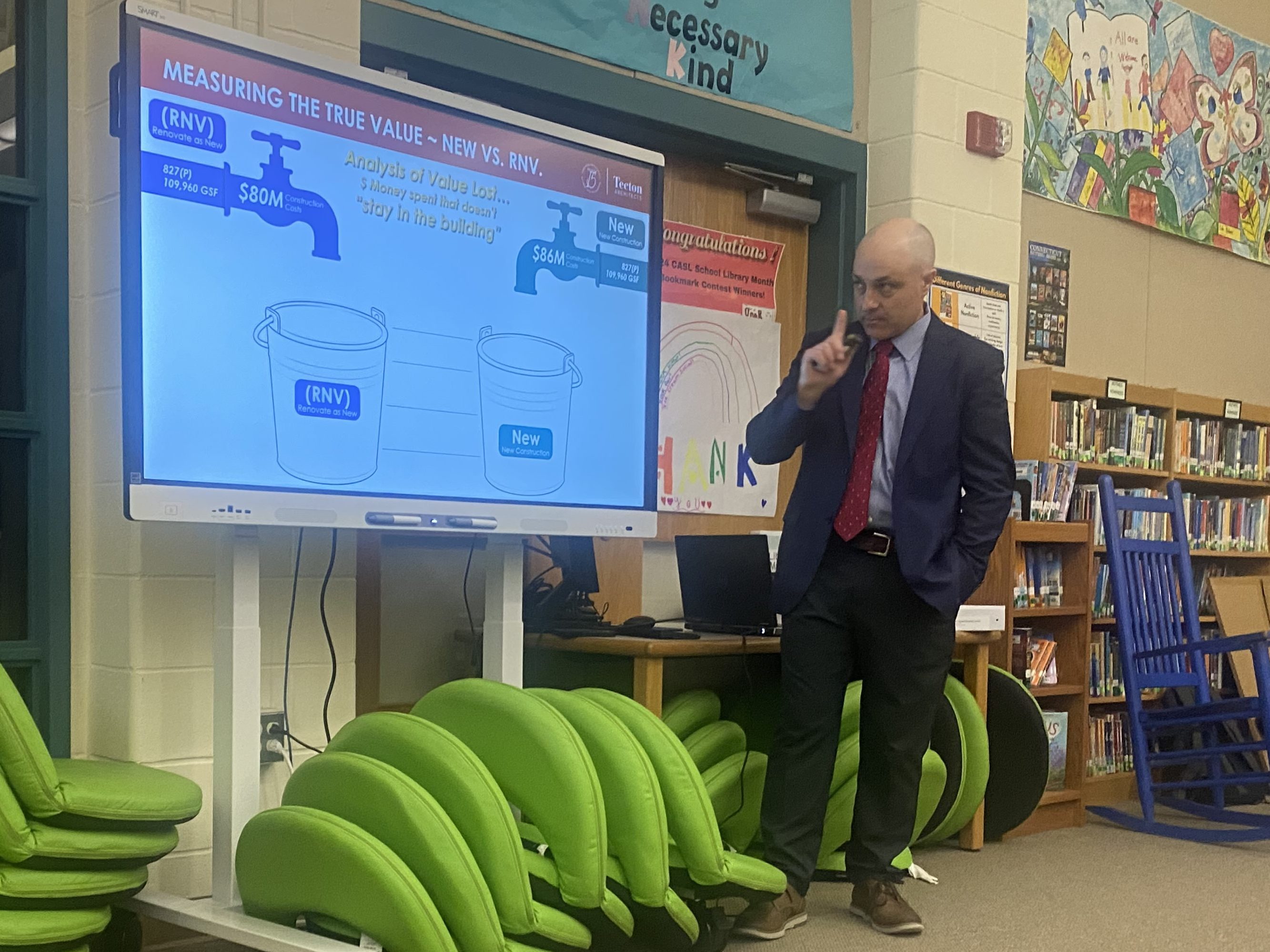
Jeff Wyszynski, an architect and Chief Operating Officer of Tecton Architects, said feedback was received regarding traffic concerns at PES, and if the land it sits on could be more valuable for another use.
He ultimately recommended that if the board decides to seek a space waiver, going through special legislation would be advisable.
However, a June 30, 2026 deadline for priority school construction grants means a referendum would have had to be held, and passed, by voters of both towns in May 2026.
“One of the items that we need to communicate clearly with the community is if you were to do that, it can only happen in this next spring session,” Wyszynski told the board members.
Land Search
Although the top option calls for 15 acres of usable land, Wyszynski said that the proposed site should be “more like a 20 or 25-acre site.”
“In this town with the topography, it’s a bit more challenging,” he said at Monday’s board meeting.
With the scope of the Feasibility Study Committee completed, discussions about acquiring the needed land have begun at the board level.
Over the summer, school officials met with members from the Southbury Land Trust and the Town of Southbury, where they reviewed all land options greater than 10 acres.
Some site analyses of potential properties, seen in the minutes of their August 19 board retreat meeting, reveal that properties like the state-owned Pierce Hollow Village, a section of town-owned land at 415 Roxbury Road, and a carved-out section of the former IBM property on Kettletown Road were all probed, but each came with its own distinct challenges.
At Monday’s meeting, Manzo said it would be premature to discuss further potential plans without a piece of property in place.
“If it turns out that the combined school on a new property is not going to be an option, then the board is going to have to decide if we are going [with the next plan],” she explained.
On Monday, the board entered into executive session to discuss the possibility of a potential real estate acquisition, with representatives from Tecton involved in the discussions.
Project architects have referenced in their plans how the Town of Cheshire is undergoing a similar process to consolidate three outdated elementary schools into two new buildings. Those schools are planned to open in the fall of 2026.
Keeping the Beat
Despite the structural challenges, the two schools are proud of their own unique identities and have produced award-winning teachers in recent years.
In their programming summary of GES, Tecton noted that the school’s music space is “too small for movement activities” and that instrument storage is lacking.
But that didn’t stop music teacher Ashley Dunne from being honored with the Milken Educator Award just two years ago. The prestigious award honors 30-40 teachers around the nation each year with a cash prize.
Dunne said that it takes a flexible staff who are willing to go the extra mile to make it work.
She recalls when architects took a tour of the school, and educators were asked about what they would like to see remain the same regarding a new or renovated school.
Without hesitation, she knew her answer.
“Is our building old? Yeah. Does it need tremendous renovation? Yeah, that’s clear. But if you’re willing to staff the building with people who really care about children, you’re going to have success,” Dunne told The Record.
Dunne’s music classroom, along with many other traditional classrooms in the building, lacks adequate storage space, she said.
“Is my music classroom huge? No. But do we do great music education? Of course,” she added.
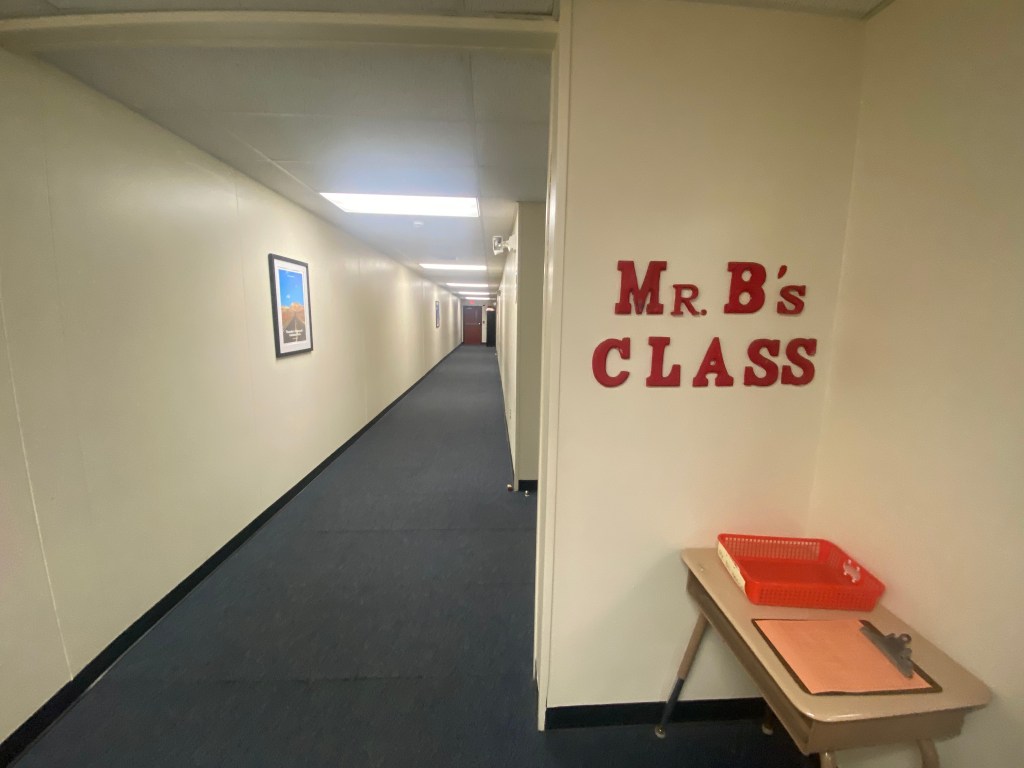
During the district’s community forums, it was noted that each school has its own unique culture, and some parents questioned how a new school culture would be formed under consolidation.
Elisabeth Larson, a Southbury parent and educator in Brookfield, attended the public forums and said that it is time for an update and that a new elementary school could draw younger families to come to town.
“There is a lot of pride in this school,” she said, standing outside of Gainfield following a tour of the school.
In Brookfield, she saw the process from an educator’s perspective with the consolidation of the town’s Center Elementary and former Huckleberry Hill Elementary Schools into a new Candlewood Lake Elementary School that opened in the fall of 2023.
“I think it will improve our town,” Larson added.
Jason Andrews, a member of the Feasibility Study Committee and a parent of two in the district, applauded the idea of a new school complex at a new site that would accommodate district-wide needs, with additional accommodations for a preschool program.
In a statement presented to the board this week, he said: “This option would also be fiscally responsible and enable us to design any future school complex to be adaptable to accommodate the future growth of this community, should it be needed in the future.”
His statement continued, “While property selection is a challenge, I wholeheartedly believe that this direction is prudent and in the best interest of all the students of this school district and the taxpayers of our respective towns.”
Timeline and Next Steps
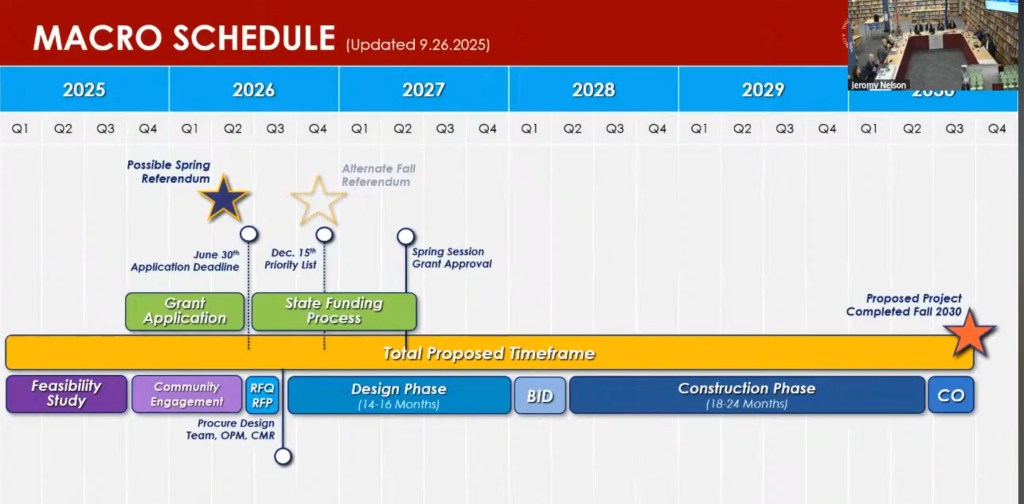
It was outlined to the board that the next logical step is to start thinking about the grant application process, which includes site due diligence, enrollment projections, establishing a building committee, and board approval on a checklist of additional items.
If the board decides it wants to submit the grant application by the June 30, 2026, deadline, then it gives them roughly nine months to do so and puts them on a timeline where a 14-16 month design phase could begin in fall 2026.
Once bids are awarded, construction would take 18-24 months, putting the expected opening on track for fall 2030.
Region 15 Superintendent Joshua Smith says he appreciates the community involvement so far in the process.
“I appreciate that the elected officials showed up and that our conversations were all about education needs first and long-term investment in the community,” said Smith.
At the district’s three public forums held for residents this spring, Smith noted the importance the community places on class size. He also has been appreciative of discussions that don’t limit the project’s scope to reimbursable square footage, rather than essential instructional space.
“As long as we don’t end up with ‘do nothing’, we’re going to make all of this work,” he said at one of the community events.
The Region 15 Board of Education meets next on Monday, October 27 at Pomperaug High School.


 The Southbury Record