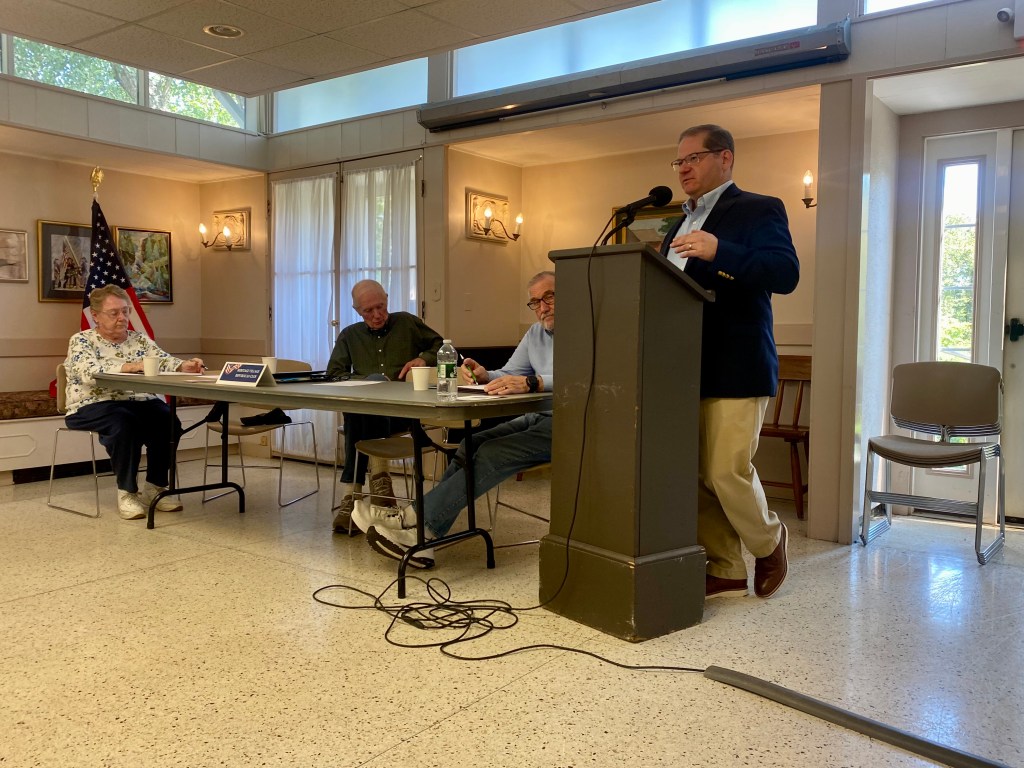
State Rep. Jason Buchsbaum visited the Heritage Village Republican Club last week, updating residents on his work in Hartford and fielding questions on energy costs.
Buchsbaum, who serves on the state legislature’s Energy and Technology Committee, said rising utility costs remain a pressing issue for many residents of the 55-and-over community in Southbury – many who live on a fixed income.
Since taking office, Buchsbaum said the top concern he’s heard is the public benefits charge on residents’ electric bills.
He spoke of the bipartisan initiative to provide some relief to electricity customers, as a $155 million package in state borrowing was approved in August, resulting in an average savings of $9 for an Eversource customer.
Buchsbaum said the measure “didn’t go nearly far enough” to lower energy bills. He sees the public benefits charge – a line item on electric bills that funds state programs – as a “hidden tax” and has been a proponent of removing the public benefits charge from electric bills and placing it into the state’s budgetary process instead.
“It makes it very difficult for people here at Heritage Village, because almost everything you have is run through electricity,” said Buchsbaum. “So your bills are disproportionately affected.”
A study by LendingTree last year revealed that Connecticut had the highest average electricity bill among the 50 states during August 2024, at $254.47, a price 37% higher than the national average.
The freshman State Representative was also questioned by members about the abrupt federal stop-work order on the Revolution Wind offshore project.
The offshore wind farm, located about 15 miles southeast of Rhode Island, started construction in 2023 and was expected to start delivering power in 2026. The project was designed to deliver enough energy to supply 2.5% of the New England region’s electricity supply, or enough to power 350,000 homes.
Although the project is 80% complete, the federal Bureau of Ocean Energy Management issued a stop-work order to halt all offshore construction on August 22, 2025.
The state’s Department of Energy and Environmental Protection (DEEP) estimates that if the project is canceled, the near-term cost to electric ratepayers in New England would be roughly half a billion dollars per year, in the form of higher regional energy market costs.
In Connecticut, ratepayers would take on 25% of the higher regional costs.
Buchsbaum said he learned of the stop-work order the same way as his constituents – by reading the newspaper.
“I can tell you that I didn’t personally receive any notice, other than reading it in the newspaper,” he said. “That’s how I learned about it.”
He said that he was in favor of evaluating all sources of energy to power Connecticut, but said he wasn’t in a position to comment directly on the aforementioned offshore wind project.
CT DEEP Commissioner Katie Dykes said in a statement, “We estimate that preventing this project from coming online will result in higher electric bills for residents and businesses in Connecticut and the region.”
The statement continued, “While these are estimates, the magnitude of these potential impacts is concerning, at a time when we want to see energy bills going down, not up. This action will also make our electric grid less reliable, leaving us more susceptible to blackouts and interruptions, particularly during heat waves and cold snaps, which are becoming more common in New England.”
Rep. Buchsbaum encouraged members to continue to reach out to state officials about their concerns regarding growing energy bills.
“You guys need to continue to be vigilant and reach out to legislators and reach out to the governor,” said Buchsbaum. “I think we’ll certainly be talking about it more, but we took a step in the right direction and did make a small reduction.”
Buchsbaum said it is not uncommon to hear from a local senior or resident of Heritage Village who cannot afford to pay their electricity bill.
“We have one of the largest senior populations in the state of Connecticut here in the town of Southbury. We need to continue to hear and understand their concerns,” said Buchsbaum.
He continued, “Today, it was about energy, but it’s not really about energy, it’s about affordability. We need to do something about that to give them relief, because all of their costs are going up.”


 The Southbury Record