The Board of Selectmen voted Thursday to send a series of charter changes to the November ballot, including questions on merging Planning and Zoning and extending the First Selectman’s term.
The board advanced four questions for voters, while striking another after the town’s attorney ruled it illegal under state law.
The charter serves as the town’s governing document, often referred to as “the bible” of how the town is structured and operated.
By the time the board took up discussion on ballot questions, a previously packed house, in attendance for the board’s decision on the four-day workweek pilot program, had filtered out of Town Hall.
Planning & Zoning Merger
The potential merger of Planning and Zoning has been a point of debate between the Charter Revision Commission (CRC), the Board of Selectmen and the two separate land use boards in recent weeks.
Supporters argue that the unification would streamline land use applications, while critics respond with “don’t fix what’s not broken” and warn of lengthy meetings and the possible loss of volunteerism.
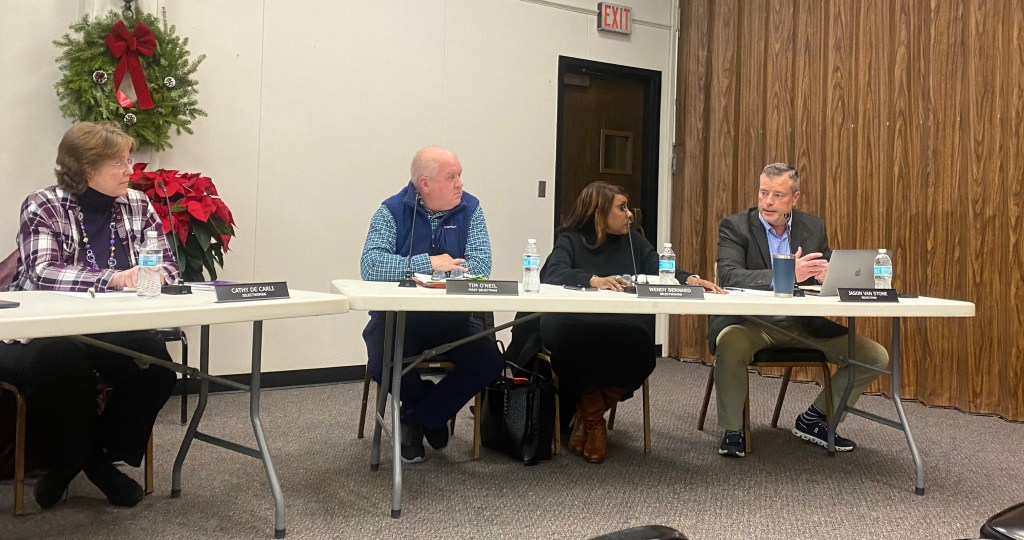
Selectmen Jason Van Stone and Anne Armeno had the privilege of being involved in discussions from both sides, due to their dual memberships on both the board and the CRC.
“We reincluded it back in the final [draft] with the thought process being that it wouldn’t be the worst thing if the voters get a crack at it,” explained Van Stone.
It was just a month ago when First Selectman Jeff Manville stated that he was against the unification of Planning and Zoning, and the board essentially requested that it be removed.
But after hearing feedback from his fellow board members, including both Tim O’Neil and Justin Bette, there was a consensus to send the question to the voters.
“I trust them to make the right decision,” said Bette of the town’s 15,000 registered voters. “It’s been done in plenty of other towns, and in more towns than those that have a four-day workweek, that’s for sure.”
First Selectman’s Term
What is likely to be at the top of the list of ballot questions this year is the possible extension of the First Selectman’s term from two to four years. This change would be put into effect for the 2027 election if passed by voters.
Arguments have been made that a four-year term could make the position more effective without immediate re-election pressure. Others say that the two-year term could serve as a stop-gap from an elected official they might be dissatisfied with.
Unsuccessful Candidate Clause
As the charter currently reads, an unsuccessful candidate for First Selectman can claim a seat on the six-member Board of Selectmen.
This question would ask voters if they would like to see this rule continued or change the charter’s wording to “no elector may be a candidate for both the office of First Selectman and that of Selectman.”
In the previous six municipal elections, this clause has been exercised by John Monteleone (2013), John Diel (2021), and Tim O’Neil (2023). Those who have chosen not to exercise the clause include Ed Edelson (2015) and Rich Boritz (2019). In 2017, First Selectman Jeff Manville ran unopposed.
Omnibus Changes
The likely final question on the ballot will be composed of a collection of smaller and technical changes to the town’s charter.
These proposed edits include the removal of the Public Appeals Board, the addition of an Emergency Services Director position, and the addition of language to allow the town to use ACH/electronic payments, not just physical checks.
It would also codify some town operations, such as the newly independent police department.
Finance Proposal Rejected
Joe Ruggiero, the chair of the CRC, alerted the board that the town’s attorney had determined that the addition of a Finance Ordinance Alternative did not stand up to state statutes.
This would have added a Section 709 to the charter, giving the Board of Finance and the Board of Selectmen an override alternative to a portion of the town’s budget process.
The now-stricken question was previously worded as an “optimization mechanism” and was a concept formed based upon feedback from the Board of Finance chair, John Michaels, and the town’s Finance Department.
What’s Next?
The Charter Revision Commission is now officially dissolved, as the temporary board has completed its tasks, which are required every five years.
What voters won’t see is the long-standing question of whether or not to have a Town Administrator or Manager position.
The proposed changes must be filed with the Secretary of State by the Town Clerk by September 19, 2025.
If changes are approved by a majority of voters, the edits would take effect in January 2026.
The Record has covered the charter process in depth. Find past reporting here:



 The Southbury Record