
The Heritage Village Democratic Club held its monthly meeting on Thursday, July 10, with guest speaker Dr. Jennifer Wojcik delivering a keynote presentation about the state of public education across the nation and in Connecticut.
Held in the Meeting House of Southbury’s Heritage Village 55-plus retirement community, Dr. Wojcik dispelled some myths about American public education and outlined some systemic barriers facing educators and students alike.
“Public education is not a spectator sport,” said Dr. Wojcik. “Because you graduated, your children graduated, it’s not over. We’re all still part of that same community that’s going to be affected by that. If you want a strong, effective school system in your community, you have to support them, not just with words, but with actions.”
The accomplished K-5 music teacher in Waterbury Public Schools spoke of a surge of misinformation surrounding the narrative of public schools. She challenged some of the most persistent myths in education, including those that say the country’s public schools are in steep decline.
She referenced the Programme for International Student Assessment (PISA) rankings, where every three years, students across the globe are administered tests focused on math, reading and science.
“U.S. students tend to score around average in math, but they score above average in both reading and science, and that alone complicates the narrative that we’re falling hopelessly behind,” said Dr. Wojcik. “Even more importantly, we need to consider who is being tested and under what conditions.”
She highlighted that comparisons to nations like China – which produces some of the highest PISA scores – can sometimes be based off of cherry-picked data to portray a certain point of view.
Additionally, PISA scores out of China may not tell the whole story, she stated.
The international PISA report includes test scores from four select provinces in China, ignoring some of the more vast and rural areas of the country.
According to the public policy organization, The Brookings Institution, 180 million students in the highly-urbanized eastern provinces of Beijing, Shanghai, Jiangsu and Zhejiang are tested, leaving out those in rural areas. China’s national population stands at 1.4 billion people in total.
Unlike many other countries, the U.S. tests all students — regardless of language ability, disability status, or socioeconomic background.
This inclusive approach, Dr. Wojcik says, reflects the nation’s commitment to equity and access to receiving an education.
“The real challenge we face isn’t that American students are somehow less capable learners,” said Dr. Wojcik. “It’s that our education system reflects deep socioeconomic divides that are present in our broader society as well.”
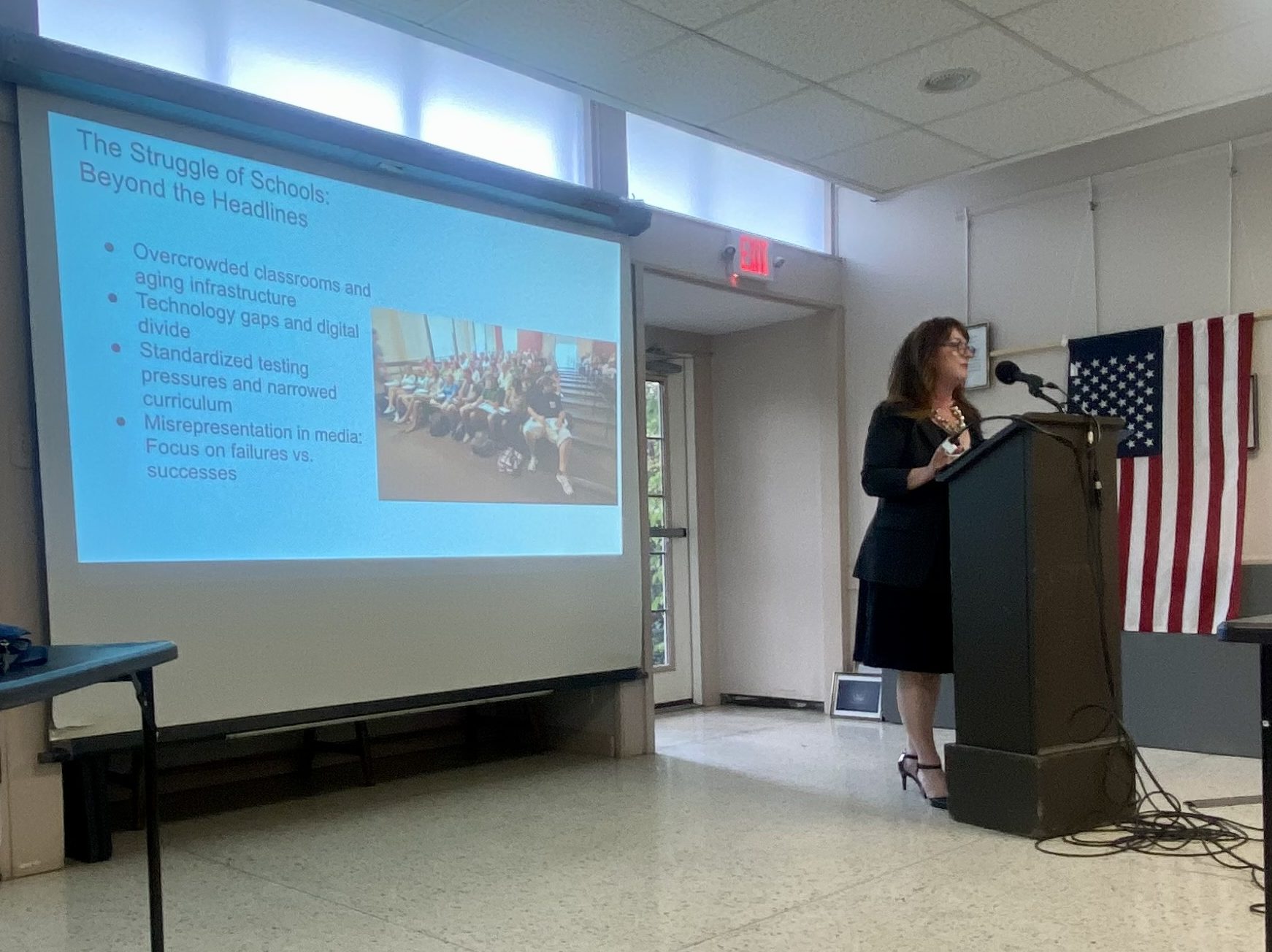
Closer to home, Connecticut routinely ranks within the top-10 states for K-12 education, according to rankings by U.S. News & World Report.
And although the Nutmeg State has a relatively well-educated population and high levels of per-pupil spending, challenges still exist, including funding inequalities.
“We have racial and economic segregation in both urban and suburban school systems,” said Dr. Wojcik.
She challenged the group of retirees to get involved at the local level, noting that in her own school district, a Foster Grandparent Program exists to provide volunteer opportunities for individuals 55 and older to support children in their classrooms.
“It’s my favorite program. I love grandparents,” said Dr. Wojcik. “I have Grandma Barbara with my first grade students, and she’s really rough around the edges, but I would take her every day.”
She added, “You can create a senior allies for education group in your town. Use your voice as a taxpayer and a voter and advocate for strong school budgets. Donate to scholarship funds. Please donate to music and arts programs. Write letters to the editor. Attend public meetings in order to amplify teacher and student needs.”
The group of nearly 40 Southbury seniors were tasked with thinking about just one way to support public education, in an effort to not just inform, but to empower change at the local level.
“You’ve spent your life building experience, and that experience is what’s going to build our future,” said Dr. Wojcik.


 The Southbury Record