
SOUTHBURY – The Heritage Village Democratic Club hosted Democratic gubernatorial candidate Josh Elliott on Thursday, March 5, as the five-term state representative from Hamden continues campaigning across Connecticut.
Elliott, 41, is mounting a Democratic primary challenge against incumbent Gov. Ned Lamont.
It’s an uphill climb by any measure.
On a rainy Thursday afternoon, Elliott walked into the Borge Room of the Heritage Village Meeting House to make his case to about 40 residents of Southbury’s 55-and-older community.
He distanced himself from Lamont by making the point that the two-term governor has not done a bad job over the last eight years, but that “the governor is not a good fit for the next four.”
Energized by a combination of Bernie Sanders’ 2016 message of economic populism, and frustrated by the reshaping of campaign finance by a 2010 Citizens United Supreme Court decision, Elliott was recruited by the Working Families Party to challenge the sitting Speaker of the Connecticut House, Brendan Sharkey of Hamden.
When Sharkey stepped aside entirely, after initially planning a ninth term, it gave Elliott roughly three months to make his pitch to voters of the 88th House District.
He ended up winning the primary by a 20-point margin, and a decade later, is currently the House’s Deputy Speaker and Caucus Co-Chair.
A Nutmeg State Poll from last month shows 13 percent of likely Democratic primary voters support Elliott, up from 7 percent in the same University of New Hampshire poll from last November.
Elliott highlighted two main points in his speech to the room of about 40 people, focusing on affordability and how he would differ from the democratic backsliding he sees when it comes to Connecticut’s response to the current federal administration.
Economy
“We have a wealth tax that is levied almost exclusively on middle class earners,” said Elliott.
“We know that the cost of childcare, health insurance, housing, transportation, food, energy, are all doubling over the past 15 years or so, while average household income does not keep pace with inflation, and capital gains have absolutely exploded… we in government are making the problem worse.”
His critique of the current governor is calculated.
He points to the $54 million in adjusted income a few years ago that the governor from Greenwich took in, according to tax records released in 2022.
“He is a nice guy,” Elliott said of Lamont. “But he is not the person who is going to solve this problem.”
Elliott claims that Lamont is “not serious” about solving affordability issues on a systemic level.
Governor Lamont’s proposed $200-per-person tax rebate for people earning less than $200,000 per year is something Elliott has described as a plan that “does nothing to change the system.”
“It’s the most ham-handed attempt at a headline I’ve seen in years,” he wrote in a campaign newsletter last month.
Part of Elliott’s platform includes implementing a progressive tax structure on those who earn more than $1 million annually.
The tax argument that he’s built his campaign around rests on a specific and repeated statistic: the top 4,500 income earners in the state pay no more than 8 percent of their income in state and local taxes. The bottom third of the state — roughly 1.2 million residents — pay at minimum 20 percent.
“We are looking to have a system where we are not just simply subsidizing the wealthy in our state,” he said.
Thursday’s stump speech also called for permanent and fully refundable child tax credits.
Two Philosophies on the Federal Threat
Elliott walked the room through Connecticut’s Trust Act – passed in 2013, 2019 and again last year – a law limiting coordination between state and local authorities, and federal immigration enforcement.
Last year’s revision included courthouse protections: no masks inside and mandatory identification for federal agents.
The governor, Elliott said, was a veto threat at every turn.
The protections were stripped from the bill to get it passed, and in the following months, masked federal agents moved through courthouse corridors. A November 2025 special session restored the courthouse protections that had been initially removed, but not before fear of potential apprehension came to fruition for some within the judicial system.
He framed the division between two lines of thought:
“There are those who say, keep your head down, don’t inflame,” said Elliott. “There are those who say, we are at an existential turning point in our nation’s history. The governor fits into the first category. I fit into the second category.”
He illustrates a sense of naïveté that comes from the current governor, while offering his candidacy as one that would stand up to what he describes as a “fascist dictatorship.”
“We need to also be ensuring that we’re putting more money towards our voting system, not less,” said Elliott, referencing the governor’s proposed budget that would cut $900,000 from operational costs for the secretary of the state’s office.
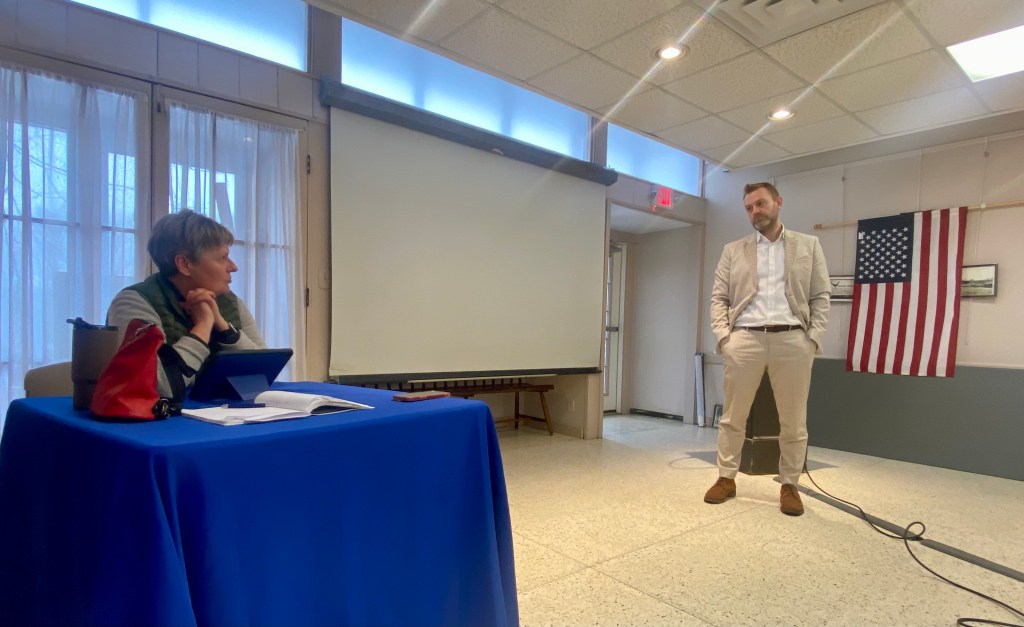
Joel Chabon, a resident of Heritage Village and a former educator, asked about the state of education at both the state level and national level, saying, “one of the reasons people move in and out of states is because of education.”
As a former homeschooled student for eight years before attending Hamden Hall for high school, Elliott spoke to the crowd about how the education system is often seen as a pipeline to a job, but how his vision of it differs.
“Our education system is to have an informed populace, period,” said Elliott.
He went on to say that universal free child care is “a must” and that with the state’s millionaires paying more under his progressive tax structure, it could fund universal child care, as well as universal free school meals.
He pointed to New York City’s model, where a universal child care initiative was recently announced that would provide care to two-year-olds (2-K), backed by $73 million to fund the first set of free 2-K seats.
“We should be following their model,” said Elliott.
Next Step on a Long Road
Over 750 people have signed up to volunteer for his campaign, and weekly phone banks have resulted in over 25,000 calls made to bring awareness to it as well.
“Then, to win them over, that’s my job,” says Elliott.
Elliott has raised about $150,000, with a goal of $340,000 to be raised to qualify for $3.4 million in public financing from the Citizens Election Program.
“I’m well on my way,” said Elliott.



 The Southbury Record